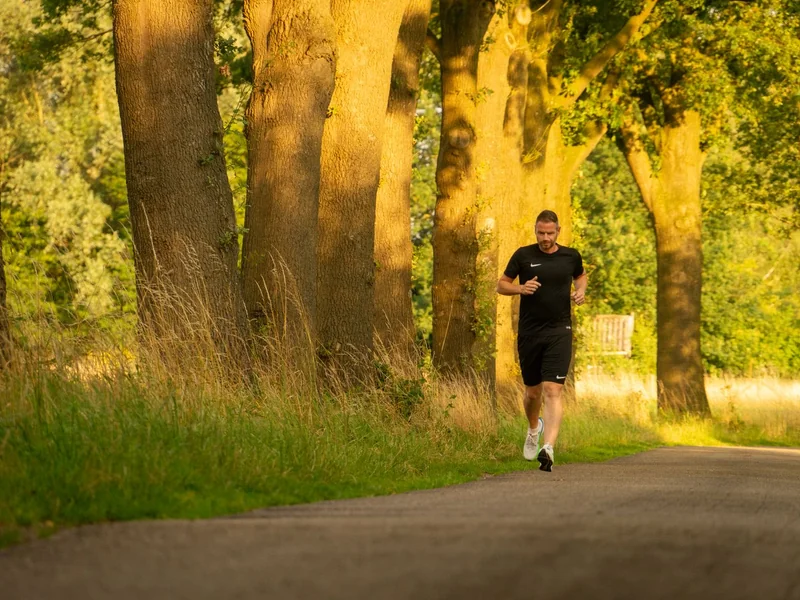
This is the first article in our 10K series. It’s for runners who can already run 3.1 miles (5km) and want to run 6.2 miles (10km) for the first time. The goal here is the distance, not a time. Whether your first 10K is an organized event or a loop around your neighborhood, the training is the same: build slowly until 6.2 miles is a run you can finish.
Are you ready to start?
You’re ready to start building toward 10K if:
- You can run 5K without stopping, at an easy, conversational effort.
- You’ve been running three times a week for at least a month, without pain that lingers from one run to the next.
- You recover between runs, rather than arriving at every run with heavy legs.
If you’ve just finished a Couch to 5K plan, give yourself three or four weeks of running at the same level first. Your heart and lungs will feel ready for more well before your bones and tendons are. Building weekly mileage safely explains why.
What changes when you double the distance
The main thing that changes is time on your feet. If your 5K takes 35 minutes, your first 10K will take well over an hour, and your legs, your feet, your fueling and your head all have to get used to being out that long.
So going from 5K to 10K is about endurance. You don’t need to run faster. You need to run for longer, and the way to do that is to run slower than you do now, more often, with one run a week that gradually gets longer.
The four rules for building up
1. Add a fourth run before you make runs longer
If you run three times a week, your first step is to add a fourth short, easy run. It spreads the extra running across the week, which is generally easier on your body than making three runs longer. The fourth run can be as short as 20 minutes.
2. Let one long run do the heavy lifting
One run a week becomes your long run, and it’s the run that takes you to 10K. It grows by half a mile (about 1km) at a time, while your other runs stay short and easy.
This puts a lot of your weekly running into one session, more than the “about a third” we usually suggest. At the low weekly totals of a first 10K build, that can’t be avoided, which is why the long run grows in small steps and every other run in the week stays short.
3. Keep everything easy
Every run in this plan is easy: heart rate zones 1 and 2, where you can talk in full sentences. If you drift into zone 3, slow down, and walk the hills if that’s what it takes.
This matters more as your runs get longer. A long run at a “comfortably hard” pace leaves you tired for days and adds stress to your legs without building more endurance. Successful endurance athletes do roughly 80% of their training at low intensity.1 When you’re building up to a new distance, you can make it close to 100%. How to build an aerobic base explains how to set your zones.
4. Avoid big jumps
Increase your total weekly distance by no more than 10% from one week to the next. If you ran 10 miles (16km) this week, run no more than 11 miles (17.5km) next week. It’s a simple, cautious limit, and it keeps the long run and the extra runs from adding up to a sudden jump.
Build for a few weeks, then take a lighter week to give your body time to catch up. After a lighter week, go back to the distance of the week before it, not straight past it.
An 8-week plan to your first 10K
The plan starts at about 9.5 miles (15km) a week, roughly what three 5K runs add up to, and builds to just over 14 miles (23km). No week is more than 10% longer than the one before it.
| Week | Easy run | Easy run | Easy run | Long run | Weekly total | Change |
|---|---|---|---|---|---|---|
| 1 | 3 miles (5km) | — | 3 miles (5km) | 3.5 miles (5.5km) | 9.5 miles (15km) | — |
| 2 | 2.5 miles (4km) | 1.5 miles (2.5km) | 2.5 miles (4km) | 3.5 miles (5.5km) | 10 miles (16km) | +5% |
| 3 | 2.5 miles (4km) | 2 miles (3km) | 2.5 miles (4km) | 4 miles (6.5km) | 11 miles (17.5km) | +10% |
| 4 | 2.5 miles (4km) | 2 miles (3km) | 3 miles (5km) | 4.5 miles (7km) | 12 miles (19.5km) | +9% |
| 5 | 3 miles (5km) | 2 miles (3km) | 3 miles (5km) | 5 miles (8km) | 13 miles (21km) | +8% |
| 6 (lighter) | 2.5 miles (4km) | 2 miles (3km) | 2.5 miles (4km) | 3.5 miles (5.5km) | 10.5 miles (17km) | −19% |
| 7 | 3 miles (5km) | 2 miles (3km) | 3 miles (5km) | 5.5 miles (9km) | 13.5 miles (22km) | +4% on week 5 |
| 8 | 3 miles (5km) | 2 miles (3km) | 3 miles (5km) | 6.2 miles (10km) | 14.2 miles (23km) | +5% |
Week 2 adds the fourth run and keeps the long run the same. The other runs get a little shorter to make room, so the week only grows by half a mile, one change at a time. Week 7 builds on week 5, not the lighter week 6, which is how the 10% limit works around a lighter week.
Space the runs out. Put a rest day, or a very short easy run, before and after the long run; most people do the long run at the weekend. Repeat weeks freely, too. If a long run felt like a struggle, run the same distance again the next week before adding more. The plan works just as well over ten or twelve weeks as eight.
Week 8 is the milestone. Your first 10K is a training run, and you don’t need a race to make it count.
What a long run looks like when you haven’t run 10K yet
From week 3 onward, every long run takes you further than you’ve ever run before. That’s a different kind of run from your usual 5K, and it helps to run it differently.
Run it slower than your normal runs
Your long run should be the slowest run of your week. If your usual easy pace is 12 minutes per mile, your long run might be 12:30 or 13:00 (7:45–8:05/km), and that’s fine. Pace is not what you’re training.
Expect your heart rate to creep up in the second half, even at the same pace. This is called cardiac drift, and it gets worse in the heat.2 Slow down to stay in zone 2 rather than holding the pace you started at.
Walk breaks are part of the plan
If you can’t stay in zone 2 for the whole distance, or your legs are tiring, plan your walk breaks rather than waiting until you have to stop. For example, run 9 minutes and walk 1 minute, all the way through. Planned breaks from the start usually get you further than running until you can’t.
Walk breaks don’t mean you haven’t “really” run 10K. You’ve covered the distance, and your body has done the work. As the weeks go on, you can make the running parts longer and the walks shorter.
Structure it in three parts
The week 8 long run might look like this:
| Part | What to do |
|---|---|
| Warm-up | Walk briskly for 5 minutes, then jog very slowly for the first mile (1.6km). This should be the slowest mile of the run. |
| The miles you know | Miles 2–3 (km 2–5). Settle into your easy long-run pace. You’ve run this far many times, so keep it relaxed. |
| The new ground | Miles 4–6.2 (km 6–10). Keep the same easy effort, even as it starts to feel harder. Take your walk breaks. Break it into chunks: one mile at a time, or one landmark at a time. |
| Cool-down | Walk for 5 minutes. Don’t stop dead and sit down. |
The last mile will probably feel heavy. That’s normal, and it’s how your body learns to run for longer. It’s different from pain, which is covered below.
Choose a route that can’t strand you
Pick flat, familiar ground, since hills push your heart rate up and a new distance is hard enough. A loop that passes your home or car, or an out-and-back route, means you’re never far from the end if something goes wrong. Measure it first with your watch or a mapping app, so you’re not guessing or adding loops at the end.
And run past your old limit somewhere you enjoy. The first time you pass 5K is a moment worth having on a nice stretch of path rather than a busy road.
What to carry and eat
For runs under about an hour, most runners need nothing. Have a drink before you go, and one when you finish. For runs over an hour, or on warm days, carry water or plan a route past a water fountain. If you’re out for more than about 75 minutes, a small amount of carbohydrate, such as a gel, a few energy chews or some sports drink, can help you finish feeling better.3
Eat a light, familiar meal 2–3 hours before. Large amounts of food or drink close to running are one of the most consistent causes of side stitches.4 Take your phone as well; it’s useful for navigation, for stopping to take a picture, or for calling for a ride if you need one.
After the long run
Eat and drink within an hour or so (a normal meal is fine), and keep the next day easy: rest, walk, or do a very short easy run.
Expect some soreness. Stiff legs for a day or two after a new longest run are normal. Soreness still there after 48 hours means you’ve done too much, so repeat that distance next week instead of adding more.
When things go wrong
- The long run feels much harder than your other runs. That’s normal. If it feels hard from the first mile, you started too fast.
- New aches at new distances. Hips, calves and feet often complain once runs pass the 45-minute mark. General soreness that fades within 48 hours is fine. Sharp, localized pain, pain on a bone, or anything that makes you limp means stop, and rest for a few days.
- You can’t finish a long run. Walk home, and repeat the previous week’s distance next time. A missed step costs you a week, not the whole plan.
- You miss a week. Go back a week and carry on. Fitness fades much more slowly than you might fear.
- You’re tired all the time. Check your sleep, your eating and how easy your easy runs are. Sleep and running performance is a good place to start.
After your first 10K
Once you’ve run 6.2 miles, repeat that long run for another two or three weeks. The first 10K proves you can do it, and the next few make it comfortable. That’s the base for everything else in our 10K series.
If you’ve entered a 10K event, try to run your first 10K in training at least two weeks before it. Make the last week before the event a little lighter: shorter easy runs and no long run. On the day, run it the way you ran your long runs. Start slowly, take walk breaks if you planned them, and enjoy the finish.
Your 5K-to-10K checklist
You’re ready to build toward 10K when you can run 5K easily and have been running three times a week for at least a month. From there, the build is about time on your feet, and you’ll run slower, not faster.
- Add a fourth run first, then grow one weekly long run by half a mile (about 1km) at a time.
- Keep every run in zones 1 and 2, with the long run as the slowest run of your week.
- Plan walk breaks on long runs from the start. They’re part of the plan, not a failure.
- Increase your weekly distance by no more than 10% a week, and take a lighter week every few weeks.
Your first 10K can be a training run. Once you’ve done it, repeat it until it feels comfortable.
This article is general information, not medical or coaching advice.
References
- Seiler S. What is best practice for training intensity and duration distribution in endurance athletes? International Journal of Sports Physiology and Performance, 2010. doi.org
- Coyle EF, González-Alonso J. Cardiovascular drift during prolonged exercise: new perspectives. Exercise and Sport Sciences Reviews, 2001. doi.org
- Jeukendrup AE. Nutrition for endurance sports: marathon, triathlon, and road cycling. Journal of Sports Sciences, 2011. doi.org
- Morton D, Callister R. Exercise-related transient abdominal pain (ETAP). Sports Medicine, 2015. doi.org