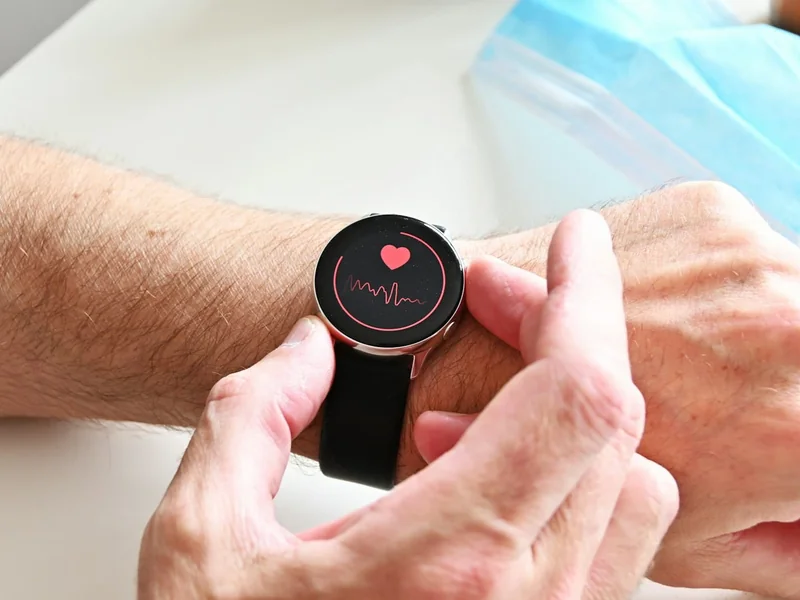
What the zones are for
Heart rate zones exist to solve one problem: effort is hard to judge from the inside. Most new runners run their easy days too hard and their hard days too easy, and a heart rate monitor is one way of making that visible.
The zones themselves are just bands of intensity, usually five of them, each set as a percentage of your maximum heart rate (max HR) and each targeting a different physiological adaptation:
| Zone | % of max HR | Feels like | Trains |
|---|---|---|---|
| 1 | 50–60% | Walking, very light | Recovery, blood flow |
| 2 | 60–70% | Comfortable, full conversation | Aerobic base, fat oxidation, capillary density |
| 3 | 70–80% | Comfortable-hard, short sentences | Aerobic capacity (the “gray zone”) |
| 4 | 80–90% | Hard, a few words | Lactate threshold |
| 5 | 90–100% | Maximal, no talking | VO₂ max (maximal oxygen uptake), anaerobic capacity |
This is the model used across all our training articles. Easy running means zones 1 and 2 only, and for a beginner that should be the overwhelming majority of running. Why the balance matters is covered in why easy runs should feel easy. What’s happening inside your body at each zone boundary is explained in the progression run.
This article is about the part underneath all of that: where the numbers come from, and how far to trust them.
The problem with 220 minus age
Every zone above is a percentage of your maximum heart rate, so the whole structure is only as good as your max HR figure. The way nearly everyone gets that number is unreliable.
The 220-minus-age formula has a standard deviation of roughly 10 to 15 beats per minute (bpm), which is far more than a rounding error. If you’re 40, the formula says your max is 180, but your true max is probably somewhere between 165 and 195. Build zones on 180 when your true max is 195 and every zone is shifted down by around 8%, which is enough for an easy run to show up as zone 3. An error in the other direction is worse, because your watch tells you a steady run is zone 2 when it isn’t.
The formula also fails in a predictable direction. Tanaka, Monahan and Seals1 analyzed 351 studies covering 18,712 individuals and found 220-minus-age overestimates maximum heart rate in young adults and underestimates it in older adults. Their alternative, 208 − (0.7 × age), has a smaller standard error and doesn’t carry that age-related bias. At 60, the two formulas differ by 6 bpm; at 25, they differ in the other direction.
Use Tanaka’s version if you’re going to use a formula at all, but remember that a better formula is still a population average being applied to one person.
Getting a number you can trust
There are four options, listed here in ascending order of usefulness.
A field test. After several weeks of consistent running, warm up thoroughly, then run hard uphill for three minutes, jog down, and repeat with everything you have left. The highest figure you see is a reasonable approximation of your max. It’s unpleasant, and it isn’t appropriate for anyone in their first months of running or with any cardiac risk factors, so do not do this as a beginner.
Lab testing. Accurate, and generally overkill unless you’re already invested.
Use lactate threshold heart rate instead. This is what most serious runners do. Threshold HR, roughly the highest heart rate you can hold for around an hour, is more stable and more relevant to training than max HR, and you can measure it yourself with the test below.
Skip testing for now. For a beginner, heart rate zones have one job, which is keeping easy runs easy. A Tanaka estimate, checked against the talk test, does that well enough. How to build an aerobic base walks through setting those zones and checking them against how you feel.
How to run a threshold field test
If you do want zones you can trust, this is the test worth doing, and it’s far less unpleasant than a max HR test.
Warm up for 15 minutes easily. Then run 30 minutes as hard as you can sustain evenly. Treat it as a time trial rather than an all-out effort; going out too fast ruins it. Use flat ground or a track if you can, since hills distort pacing. Take your average heart rate over the final 20 minutes and treat that as your threshold heart rate.
Zones are then set from that figure rather than from max HR:
| Zone | % of threshold HR |
|---|---|
| 1: Recovery | Below 81% |
| 2: Aerobic | 81–89% |
| 3: Tempo | 90–94% |
| 4: Threshold | 95–99% |
| 5: VO₂ max | 100%+ |
Threshold heart rate is more stable day-to-day than max HR estimates. Unlike max HR, it also moves as you get fitter, so retesting every few months gives you a useful progress marker. Don’t attempt this in your first few months of running; it needs a base of consistent training behind it.
The two systems don’t line up exactly, and the threshold zones above won’t give the same bpm figures as the max HR zones used in our session articles. Pick one system and stick with it. Whichever you use, an easy run should still pass the talk test.
Why a well-set zone still moves
Even a well-tested zone is a figure taken on one day, in one set of conditions, and heart rate at the same effort doesn’t stay put.
On a long run at constant effort, heart rate climbs steadily as fluid is lost and core temperature rises, often by 5–10 bpm over an hour. This is cardiac drift. The season matters as well: a warm day can add 10 or more bpm at identical pace, so zones set in March mean something different in July.
Then there’s lag. Heart rate takes a minute or more to catch up with a change in effort, and wrist sensors lag further still. It reads low at the start of a run and through short fast reps, which is why our threshold intervals session has you judge the first rep by effort, not by your watch.
None of this means your zones are wrong. Keep the zone fixed and let your pace adjust to it: slow down as your heart rate drifts up, rather than recalculating your zones. The everyday causes of a high reading on an easy run, such as poor sleep, caffeine, hills or a wrist sensor locking onto your cadence, are covered in how to build an aerobic base.
Which approach to use
If you’re new to running, or in a base phase, use the Tanaka estimate, checked against the talk test, and a chest strap if you can. That’s all you need, and the aerobic base guide covers the setup. If you’re training with regular hard sessions, do the threshold test once you have a few months of consistent running behind you, and retest every few months.
Either way, easy means zones 1 and 2 only. If your watch shows zone 3, or you can’t speak in full sentences, slow down or walk. When the watch and your breathing disagree, go with whichever one tells you to ease off.
Setting your zones in practice
The main job of zones is keeping easy runs easy. The 220-minus-age formula carries a ±10–15 bpm standard deviation and is biased by age, so use 208 − (0.7 × age) instead. Even then, a formula-derived max is an average applied to an individual. Threshold-based zones are more reliable if you want precision, but don’t mix the two systems.
Drift, heat and lag all move your heart rate at the same effort, so keep the zone fixed and let your pace change. When your watch and your breathing disagree, go with whichever tells you to slow down.
This article is general information, not medical advice. Speak to a doctor before maximal exertion testing, particularly if you have any cardiac risk factors.
References
- Tanaka H, Monahan KD, Seals DR. Age-predicted maximal heart rate revisited. Journal of the American College of Cardiology, 2001. pubmed.ncbi.nlm.nih.gov