The real question
Most people asking whether expensive running shoes are worth it aren’t elite racers. A more typical runner goes out three times a week for 3–6 miles (5–10km) and is looking at a $250 shoe next to a $130 one.
For that runner, the short answer is usually no. A comfortable, mid-priced daily trainer gives you nearly everything that matters. The extra money buys real technology, but that technology was built for racing fast, and it gives you the least at the paces and mileage most recreational runners do.
The longer answer depends on what you’re paying for.
What the extra money buys
Above about $150, the price usually reflects three things.
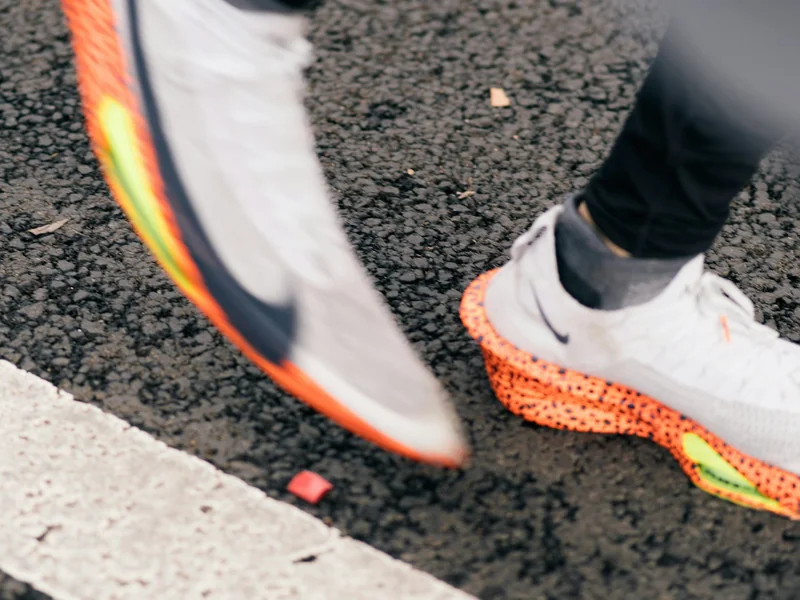
Newer midsole foams. Most budget and mid-priced shoes use foams based on EVA (ethylene-vinyl acetate), which are durable, stable and cheap to make. Premium shoes increasingly use PEBA (polyether block amide) and similar “supercritical” foams, which are lighter, softer and return more of the energy you put into them. They feel bouncy, and in racing shoes they’re the main reason the shoes are fast.
Carbon plates. A stiff, curved plate runs the length of the midsole. It stabilizes the tall, soft foam and changes how the shoe rolls through each stride. Plates get most of the attention in marketing, but the research suggests they’re not the main source of the benefit (more on that below).
Brand premium. Some of the price is the newest colorway, the launch hype, and the cost of marketing a flagship model. Last year’s version of the same shoe is often nearly identical.
What the extra money doesn’t reliably buy is comfort or injury protection. When researchers in the UK tested low-, mid- and high-priced shoes from three major brands, they found no meaningful difference in cushioning, and comfort ratings had no link to price.1 The cheaper shoes cushioned slightly better, though the difference wasn’t statistically significant. That study is older and predates modern foams, but its central point still holds: price isn’t a proxy for how a shoe will feel on your foot.
What the super-shoe research shows
“Super-shoes” are racing shoes that combine a resilient high-performance foam, a stiff plate, and a tall stack. The research behind them is real, but it comes with an important condition.
The study that started it all tested 18 highly trained male runners at speeds from about 6:54 down to 5:22 per mile (4:17 to 3:20 per km). The prototype shoe reduced the energy cost of running by about 4% on average compared with established racing shoes, and every runner benefited, though individual results ranged from about 1.6% to 6.3%.2
Those speeds are far quicker than most recreational running. When a later study tested a super-shoe at slower speeds, the benefit shrank. At about 8:03 per mile (5:00 per km), oxygen use fell by about 1.4%. At about 9:39 per mile (6:00 per km), it fell by about 0.9%.3 The shoes still helped, but much less. We look at what that means for everyday runners in do super shoes help at 10-minute mile pace?
A third study cut through the carbon plate in a super-shoe so it no longer stiffened the shoe, and running economy barely changed.4 The researchers concluded that the energy savings come from the foam, geometry and plate working together, rather than from the plate on its own. So a “carbon” label doesn’t guarantee much.
Who benefits most:
- Runners racing at fast paces, where the savings are largest.
- Runners who care about the result of a specific race, where 1–2% can be worth paying for.
Who benefits least:
- Runners doing easy mileage at conversational pace, which should be most of your running anyway.
- Anyone running 3–6 miles at a time with no race in sight.
Super-shoes can also feel unstable at slower paces, because a tall, soft stack is harder to control when you’re not moving quickly. Many runners find them awkward for everyday miles.
When a mid-priced daily trainer is enough
For most recreational runners, a daily trainer in roughly the $120–150 range is all the shoe they need. That covers you if:
- Your runs are mostly easy.
- You’re not training for a time goal.
- You run fewer than about 20 miles (32km) a week.
The criterion that matters most is the one covered in Choosing the Right Running Shoes: comfort, judged by you, when you run in the shoe. A $130 shoe that feels right will serve you better than a $250 shoe that doesn’t.
If you want something that feels livelier without going all the way to a race shoe, many brands now put their newer foams into mid-priced trainers. You get some of the bounce without the plate, the price or the fragility.
Cost per mile
Price on its own is misleading. What you’re really paying is cost per mile.
Take a runner doing three runs of 3–6 miles a week. That’s about 9–18 miles (15–29km) a week, or roughly 470–940 miles (750–1,500km) a year.
| Shoe | Price | Typical lifespan | Cost per mile |
|---|---|---|---|
| Mid-priced daily trainer | $130 | 400 miles (640km) | about $0.33 |
| Premium daily trainer | $180 | 400 miles (640km) | about $0.45 |
| Carbon-plated racing shoe | $250 | 200–300 miles (320–480km) | about $0.83–1.25 |
Lifespans vary a lot by shoe and runner, so treat these as planning figures. The pattern still holds: racing shoes use lighter, softer materials built for race day rather than durability, so you pay more for each pair and get fewer miles from it. Using one for every run can cost two and a half to nearly four times as much per mile as a solid daily trainer.
Plenty of runners solve this by keeping a racing shoe for races and the occasional key workout, and doing everything else in a daily trainer. Spread that way, the racing shoe can last for years. Our Running Shoe Rotation guide covers when a second or third pair is worth adding.
Ways to save
- Buy last season’s model. Shoes are updated every year or so, often with small changes. The outgoing version is regularly discounted by 20–40% once the new one arrives.
- Check return policies before you buy. Some running retailers and brands let you return shoes within a set period even after you’ve run in them. That takes the risk out of trying a pricier pair, because you can test it on real runs. Read the terms first, since the rules differ.
- Buy your favorite shoe twice. Once you’ve found a model that works, buying a second pair on sale is cheaper than paying full price later, and it gives you a rotation.
- Get the full lifespan. Replace shoes when new aches appear or the midsole looks visibly compressed, not because a mileage figure says you’re due.
Quick decision guide
| Your running | What to buy |
|---|---|
| Under 15 miles (24km) a week, no race goals | One mid-priced daily trainer that feels comfortable. |
| Under 15 miles (24km) a week, with a race coming up | A daily trainer for training. A racing shoe is optional and a small gain at most. |
| 15–30 miles (24–48km) a week, running for fitness | Two daily trainers in rotation, ideally bought on sale. |
| 15–30 miles (24–48km) a week, chasing a time goal | A daily trainer for most runs, plus a racing shoe kept for races and a few key sessions. |
| Over 30 miles (48km) a week, racing seriously | A rotation of a daily trainer, a faster shoe for workouts, and a racing shoe. |
For the runner in our opening question, running three times a week for 3–6 miles, the $250 shoe isn’t wasted money if you love how it feels and can afford it. It’s just not where the value is. Spend $130 on a shoe that’s comfortable, and if you want to spend the extra $120 on running, a pair of good running socks and a race entry will do more for you.
Common questions
Are expensive running shoes worth it for beginners?
Usually not. For a runner doing mostly easy runs of 3–6 miles (5–10km) a few times a week, a comfortable mid-priced daily trainer in roughly the $120–150 range gives you nearly everything that matters. The technology in pricier shoes was built for racing fast, and it helps least at easy paces.
Do carbon plate running shoes make you faster?
They can, but mostly at fast paces. In highly trained runners, super-shoes cut the energy cost of running by about 4% on average, while at about 9:39 per mile (6:00 per km) the saving fell to about 0.9%. Research also suggests the benefit comes from the foam, geometry and plate working together, not from the plate on its own.
Are more expensive running shoes more comfortable?
Not reliably. When researchers tested low-, mid- and high-priced shoes from three major brands, they found no meaningful difference in cushioning, and comfort ratings had no link to price. Judge comfort by running in the shoe, not by the price tag.
How can I save money on running shoes?
Buy last season’s model, which is regularly discounted by 20–40% once the new version arrives. Once you’ve found a shoe that works, buy a second pair on sale, check return policies before trying a pricier pair, and replace shoes when new aches or a compressed midsole appear rather than on a fixed mileage.
This article is general information, not medical advice.
References
- Clinghan R, Arnold GP, Drew TS, Cochrane LA, Abboud RJ. Do you get value for money when you buy an expensive pair of running shoes? British Journal of Sports Medicine, 2008. bjsm.bmj.com
- Hoogkamer W et al. A comparison of the energetic cost of running in marathon racing shoes. Sports Medicine, 2018. ncbi.nlm.nih.gov
- Joubert DP, Dominy TA, Burns GT. Effects of highly cushioned and resilient racing shoes on running economy at slower running speeds. International Journal of Sports Physiology and Performance, 2023. pubmed.ncbi.nlm.nih.gov
- Healey LA, Hoogkamer W. Longitudinal bending stiffness does not affect running economy in Nike Vaporfly shoes. Journal of Sport and Health Science, 2022. ncbi.nlm.nih.gov