The short answer
Yes, on flat ground they probably do. A 2026 trial tested super shoes on moderately trained recreational runners at paces from about 8:03 to 12:52 per mile (5:00 to 8:00 per km). The shoes lowered the oxygen cost of running by about 2.5% on average, and the saving didn’t shrink at the slower speeds.1
On hills, they help much less. A second 2026 study found that the benefit fell from about 4.2% on the flat to 0.5% on a steep 9% incline.2
So the answer to “should I buy them?” depends less on how fast you run than on where you run and what you’re running for.
Why this question keeps coming up
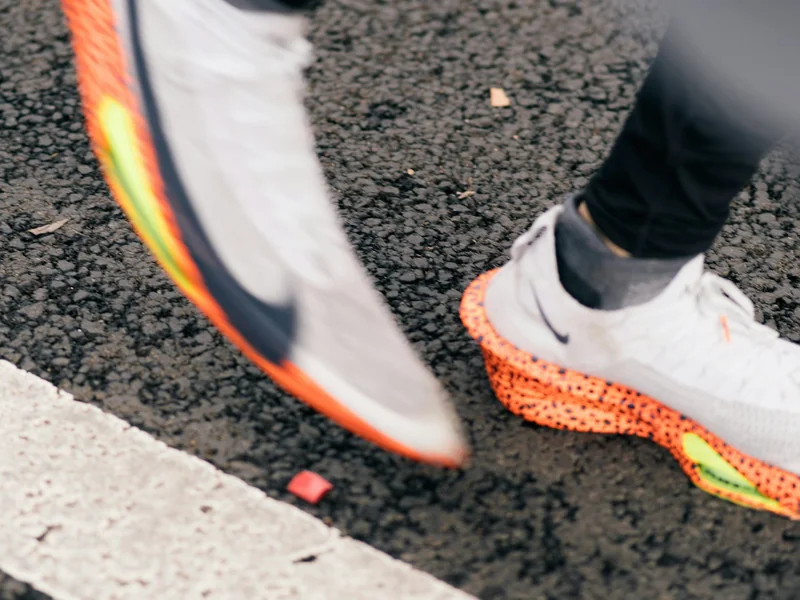
Super shoes combine a light, very bouncy foam, usually PEBA (polyether block amide), with a stiff curved plate and a tall stack. The research that made them famous tested highly trained runners at about 5:20–6:55 per mile (3:20–4:17 per km) and found they cut the energy cost of running by about 4%.3
Most runners aren’t anywhere near those paces. If your 10K pace sits around 10 minutes per mile (6:13 per km), it’s fair to ask whether a shoe designed for elite marathoners does anything for you. Some earlier work suggested it does less: one study found savings of only about 1.4% at 8:03 per mile and 0.9% at 9:39 per mile.4 We covered that research, and what the extra money buys, in Are Expensive Running Shoes Worth It?
The new trial was designed to answer the slower-pace question directly.
The 2026 slow-speed trial
Researchers in Switzerland recruited 14 moderately trained runners: 6 men and 8 women, with an average age of about 25. To qualify, they had to have run a half marathon in 1:30–2:30 or a 10K in roughly 40–70 minutes, so 10-minute-mile runners were well within the range.1 Most of them had never worn super shoes before.
Each runner tested three shoes on a treadmill, in random order:
- A traditional cushioned trainer, 277 g, with no plate.
- A super shoe with PEBA foam and a carbon fiber plate, 215 g.
- A heavier prototype mixing a nylon plate with PEBA and standard foams, 312 g.
They ran 3 minutes at each of four speeds, and repeated the whole protocol on three separate days. Repeating it matters, because single lab sessions are noisy. When the researchers looked at one day’s data alone, the effect was much harder to see.
What they found
The super shoe cut oxygen cost at every speed compared with the traditional trainer:
| Treadmill speed | Pace per mile (per km) | Saving vs. traditional trainer |
|---|---|---|
| 4.7 mph (7.5 km/h) | 12:52 (8:00) | about 2.3% |
| 5.6 mph (9.0 km/h) | 10:44 (6:40) | about 3.0% |
| 6.5 mph (10.5 km/h) | 9:12 (5:43) | about 2.4% |
| 7.5 mph (12.0 km/h) | 8:03 (5:00) | about 2.4% |
Percentages calculated from the study’s group averages. The authors report a range of 2.3–3.1%.
A 10-minute mile falls between the second and third rows, where the saving was about 2.4–3%. Statistically, the benefit didn’t depend on speed at all. That contradicts the idea that super shoes only work once you’re running fast.
The heavy prototype did no better than the traditional trainer. A plate and some PEBA foam weren’t enough on their own: the shoe was nearly 100 g heavier than the super shoe, and it lost.
The catches
- Some of the saving is weight. The super shoe was 62 g lighter per shoe than the trainer. Researchers estimate about 1% extra energy cost per 100 g of shoe weight, so roughly 0.6 percentage points of the 2.5% may be weight alone. Even so, the rest is a real effect.
- You won’t feel much of it. Heart rate was only about 1.6 beats per minute (bpm) lower in the super shoe, and perceived effort dropped by 0.2 points on a 10-point scale. A saving can be real and still hard to notice on a single run.
- One brand, one lab. All three shoes came from one manufacturer, and testing was on a treadmill in short bouts. The study didn’t measure race times.
- Comfort still matters. On average, comfort ratings didn’t differ between the shoes. But each runner’s least-liked shoe cost them measurably more oxygen than their favorite. A super shoe that doesn’t suit your feet isn’t a super shoe for you.
Why hills shrink the benefit
The second study, from the University of Leeds in the UK, asked a different question: what happens when the road tilts up?2
Twelve competitive male runners (average 5K time about 16:22) ran at 7.5 mph (12 km/h), which is 8:03 per mile (5:00 per km), at four treadmill inclines. They wore a carbon-plated super shoe and, as the comparison, a lightweight racing shoe that also uses PEBA foam but has a flexible plastic plate and a thinner midsole.
| Incline | What it’s like | Benefit of the super shoe |
|---|---|---|
| 0% | Flat road | 4.22% |
| 3% | Gentle, rolling road hill | 2.42% |
| 6% | A hill you’d call steep | 1.05% |
| 9% | A hard hill-repeat hill | 0.52% |
The benefit fell by roughly a fifth for every 1% of extra incline. At 6% and 9%, the difference between the two shoes was too small to detect reliably, and the authors concluded it was unlikely to make a meaningful difference to performance.
The reason comes down to how the shoes work. On flat ground, a lot of each stride involves landing, compressing and springing back. The foam and plate store some of that energy and give it back, so your muscles do less work. Going uphill, more of your effort goes into lifting your body against gravity, and there’s less impact and braking to recycle. The spring has less to work with.
Going downhill wasn’t tested. Earlier research found a similar percentage benefit on a gentle downhill, but downhill running costs much less energy to begin with, so the actual saving is small.5 On a rolling course, the authors suggest, nearly all of a super shoe’s advantage comes from the flat sections and gentle climbs.
Does the hill finding apply at 10-minute pace?
That hasn’t been tested directly. The hill study used fast runners at 8:03 pace, not recreational runners at 10:00. The explanation the authors give is about the physics of the shoe and of running uphill, and that doesn’t depend much on how fast you are. Expect the same pattern at your pace, even if the exact numbers differ.
What it means for your running
Flat road races: worth considering
If you race on flat or gently rolling roads and care about your time, super shoes are likely to help, even at 10-minute-mile pace. Economy gains don’t turn one-for-one into speed, but here’s what small improvements in pace would mean at 10:00 per mile:
| Race at 10:00/mile | Finish time | 1% faster | 2% faster |
|---|---|---|---|
| 5K | 31:04 | 19 seconds | 37 seconds |
| 10K | 1:02:08 | 37 seconds | 1:15 |
| Half marathon | 2:11:06 | 1:19 | 2:37 |
| Marathon | 4:22:11 | 2:37 | 5:15 |
That’s a useful margin if you’re chasing a personal record (PR). It’s no substitute for training. A few months of consistent mileage will do more, and our ranking of legal performance boosters puts super shoes in context with caffeine and other options.
Hilly courses: the gain shrinks
A hilly course doesn’t wipe out the benefit, but it reduces it in proportion to how much of the race is spent climbing anything steeper than a gentle grade. A road race with a few short climbs still gets most of the flat-ground saving. A course dominated by long, steep hills gets much less.
Trails and mountains: skip them
Steep, technical climbs are where super shoes help least, and the tall, soft stack is less stable on uneven ground. The Leeds authors point to mountain running research that found no performance advantage from super shoes. A good trail shoe with grip is the better buy.
Incline treadmill and hill repeats: no point
If you do hill sessions on a treadmill at an incline of 6 or above, or repeats on a steep hill, super shoes give you almost nothing. Save the foam.
Easy runs: not needed
Easy runs should be run by effort, in heart rate zones 1–2, not by pace (see Why Easy Runs Should Feel Easy). A 2–3% saving in oxygen cost doesn’t make an easy run more useful. It just means you’d run slightly faster at the same effort, which isn’t the point. Super-shoe foam also wears faster than a daily trainer’s, so using them every day costs more per mile. Most runners keep a pair for races and a few key sessions, and train in something cheaper. Our shoe rotation guide covers how to split it.
How strong is the evidence?
Moderate to strong. Both studies were randomized crossover trials, meaning every runner tested every shoe, in a random order, which is the right design for this question. The slow-speed trial repeated its measurements on three days, which makes its results more reliable than most.
The limits are real, though. The samples were small (14 and 12 runners), testing was on lab treadmills in bouts of a few minutes, and each study used one brand’s shoes. The hill study included only men. Neither measured actual race performance. Studies also disagree on the size of the effect at slower paces, from under 1% to about 3%, partly because they compared super shoes against different control shoes. What they agree on is that the effect is above zero on flat ground.
Individual results vary, too. Some runners gain more than the average, and a few gain nothing. The only way to know how you respond is to try a pair, ideally from a retailer that accepts returns after a test run.
Quick decision guide
| Your situation | Super shoes? |
|---|---|
| Racing a flat road 10K, half or marathon, chasing a time | Likely worth it, if they feel good on your feet |
| Racing a hilly road course | Still some benefit, but smaller |
| Trail or mountain racing | No. Buy a trail shoe |
| Hill repeats and incline treadmill sessions | No |
| Easy runs and everyday training | Not needed; a comfortable daily trainer is better value |
| Running for fitness, no race planned | Optional. Buy them if you love them, not for the numbers |
This article is general information, not medical advice.
References
- Bolliger F, Spengler CM, Beltrami FG. Impact of advanced footwear technology on running economy at slower running speeds: a randomised, cross-over investigation. Sports Medicine – Open, 2026. ncbi.nlm.nih.gov
- Askew GN, Hill S, Payne M, Stewart TD, Charles D, Brown AP. Running economy benefits of shoes incorporating advanced footwear technology decrease with increasing incline and are negligible above moderate gradients. Scandinavian Journal of Medicine & Science in Sports, 2026. eprints.whiterose.ac.uk
- Hoogkamer W et al. A comparison of the energetic cost of running in marathon racing shoes. Sports Medicine, 2018. ncbi.nlm.nih.gov
- Joubert DP, Dominy TA, Burns GT. Effects of highly cushioned and resilient racing shoes on running economy at slower running speeds. International Journal of Sports Physiology and Performance, 2023. pubmed.ncbi.nlm.nih.gov
- Whiting CS, Hoogkamer W, Kram R. Metabolic cost of level, uphill, and downhill running in highly cushioned shoes with carbon-fiber plates. Journal of Sport and Health Science, 2022. doaj.org