What cadence is
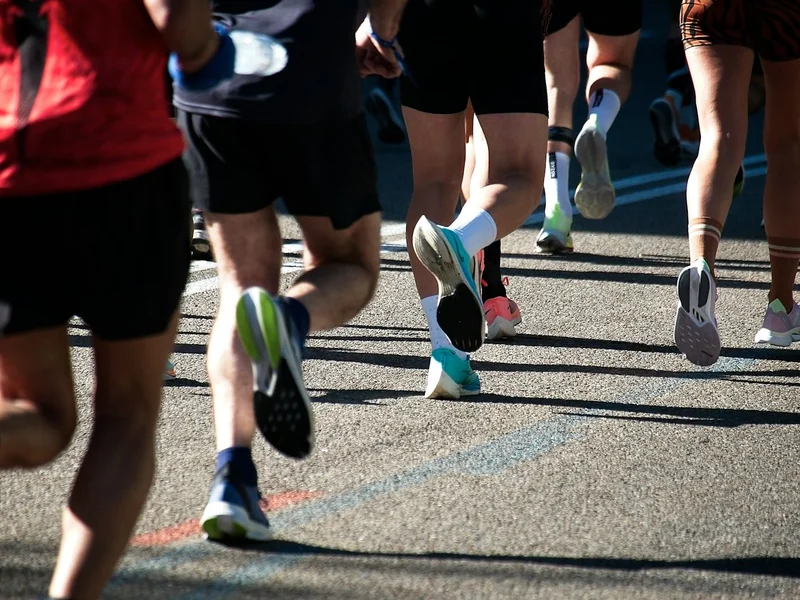
Cadence is the number of steps you take per minute (spm), counting both feet. Most running watches show it, and most runners who look at the number eventually hear the same advice: aim for 180.
Speed is two things multiplied together: how long each step is and how many steps you take. Run at the same pace with a higher cadence and each step has to be shorter. That trade, shorter steps taken more often, is what all of the research below is about.
Typical recreational runners sit somewhere around 150–175 spm at an easy pace. Whether that is a problem depends on who you are, how fast you’re running, and whether anything hurts.
Where 180 came from
The number traces back to coach and exercise physiologist Jack Daniels, who counted the step rates of distance runners at the 1984 Los Angeles Olympics. Almost all of them were at 180 spm or higher, and he noted that the beginners he coached were almost always below it.
The context got lost as the advice spread. Those were elite athletes racing at elite speeds, and cadence rises with speed, a finding repeated in almost every study on the subject.1 Daniels described a floor that Olympic runners happened to sit above. Nothing in that observation supports applying a race-pace number from Olympic finalists to a 12-minute-mile easy run.
Is cadence set by your height and body size?
Partly, though less than you’d think.
Leg length matters moderately. A study of 82 recreational runners found that longer legs went with a lower cadence (a moderate correlation, r = −0.45), whether or not the runners were injured.2
Speed matters as much. At the 2016 100km (62-mile) World Championship, competitors averaged 182 spm but ranged from 155 to 203, and leg length and running speed together explained only about half of the difference between runners.3 The same runner’s cadence rose and fell with pace through the race, by about 5–6 extra steps per minute for every 2.2 mph (1 meter per second) faster.
The other half comes down to the individual. Tendon stiffness, strength, running experience and plain habit all play a part, so two runners of the same height can have very different natural step rates and both be fine.
A tall runner with long legs sitting at 160 spm at an easy pace is not necessarily doing anything wrong, and a shorter runner at 180 isn’t necessarily doing anything right. A single universal number doesn’t fit the evidence. Your own baseline, at your own easy pace, is the only useful starting point.
The case for a higher cadence
This is where the evidence is strong. When researchers hold speed constant and ask runners to take shorter, quicker steps, the load on the knee and hip drops consistently.
In 45 recreational runners, raising step rate by 5–10% above their natural rate reduced the energy absorbed at the knee and hip, shortened the stride, cut vertical bounce and reduced braking with each step.4 A systematic review of the research reached the same conclusion: a higher step rate reduces several of the biomechanical factors linked to running injuries.5 The kneecap benefits too. A 10% increase in step rate lowered peak patellofemoral (kneecap) joint force by 14%, mainly because the knee bent less on landing.6
It also helps runners who already have knee pain. Runners with patellofemoral pain (PFP), often called runner’s knee, who were retrained to a 10% higher step rate improved their pain and function, and the improvement held at three months.7 This is the best-supported use of cadence change.
There may be a link with shin injuries as well. In 68 high school cross-country runners followed through a season, those in the lowest third for step rate (164 spm or below) had around six times the odds of a shin injury compared with the highest third (174 or above).8 The sample was small and the confidence intervals wide, so treat it as a signal rather than proof. The same study showed no link with knee pain.
Most of this benefit comes from what a higher cadence prevents: overstriding, where the foot lands well out in front of the body with a straight knee, which acts like a brake with every step.
The case against (or at least, for caution)
The drawbacks get far less airtime, but they matter.
More steps means more loading cycles. A shorter stride means more steps per mile, and when runners raised their step rate by 7.5%, the force on the knee per step fell by around 8–11%, but because they took more steps, the total knee load over the same distance didn’t change.9 Lower peak loads may still be kinder to tissue, but the idea that cadence simply “reduces load” is an oversimplification.
Load also moves around rather than disappearing. Higher step rates reduce stance-phase loads but increase some muscle forces during the swing phase of the stride, particularly the rectus femoris (front of the thigh) and the hamstrings.6 And the link with load rate is weaker than often claimed. Once cadence was adjusted for leg length, it showed no relationship with how quickly impact force built up, which is one of the measures cadence advice is usually meant to fix.2
Forcing a number can cost energy. Your body is good at choosing an economical step rate, and experienced runners naturally settle close to their most efficient cadence.10 Pushing far above it (chasing 180 from a natural 155, for instance) makes running feel awkward and can raise effort, at least until you adapt.
Finally, there is no proof that it prevents injury in healthy runners. Almost all of the positive evidence is biomechanical (lab measurements of force and joint angles) or comes from runners who are already injured. No large trial has yet shown that raising cadence prevents injuries in healthy runners.
Does a slow cadence matter?
It depends on what “slow” means.
If your cadence is low because you’re running slowly, that’s normal. Cadence drops as pace drops, so a lower number on easy runs is expected, and comparing your easy-run cadence to a figure measured at race pace tells you nothing.
A low cadence that comes from overstriding is worth addressing. If your foot lands well ahead of your hips with a straight leg, a modest increase in step rate is one of the simplest ways to fix it.
Novice runners are also more likely to sit below their optimum. Trained runners tend to choose a cadence close to their most efficient, while novices tend to run at lower-than-optimal step rates.10 In one lab study of less experienced runners, the most economical stride rate was around 4–8% higher than the one they chose naturally.11 That’s a small gap of a few steps per minute, nowhere near a jump to 180.
If you’re pain-free and running comfortably, a slow cadence on its own is not a reason to change anything.
Can you train a higher cadence, and should you?
You can. Cadence is one of the most trainable parts of running form, and the changes stick. A 6-week retraining program with a 10% cadence increase did not reduce running efficiency, and runners kept some of the improved mechanics even when back at their natural pace.12 Runners who trained with a 7.5% increase using real-time feedback from a wrist-worn running watch over eight normal runs still showed lower knee loads a month later.9 Well-trained female runners who practiced running at 180 spm for 15 minutes a day over 10 days used about 11% less oxygen at the same speeds afterward,13 though it was a small study, so the size of that effect should be treated with caution.
Whether you should depends on your situation.
It’s worth trying if you have knee pain (especially at the front of the knee), recurring shin problems, or you can see yourself clearly overstriding on video. Ideally, work with a physical therapist who can confirm cadence is the right lever.
It’s probably not worth the attention if you’re a beginner who is pain-free. In the first months, pace and consistency matter far more (see common beginner running mistakes), and many form issues ease on their own once easy runs are kept easy.
And it’s not worth forcing if you’re healthy, efficient and running well at your natural rate, whatever that number is.
How to raise your cadence safely
- Find your baseline. Check your watch’s average cadence on a flat, easy run, or count your right-foot steps for 30 seconds and multiply by four.
- Aim for 5–10% more, not 180. At a baseline of 160, that’s 168–176, and the research benefits appear within this range.4, 7
- Keep your pace the same. The goal is shorter steps, not running faster; if your pace creeps up, you’ve lost the point of the exercise.
- Use a metronome. Most running watches and free phone apps can play a beat at your target cadence, or you can use a playlist at that tempo. Run short blocks of a few minutes to it during easy runs.
- Think “quick and light,” and aim to land with your foot closer to underneath your body rather than reaching forward.
- Build it in gradually. Use it for part of a few runs a week, extending the blocks over several weeks until the new rhythm feels natural without the beat.
- Watch your calves and Achilles. Shorter, quicker steps can shift a little more work to the lower leg. Some mild calf tiredness early on is normal; pain that lingers the next day is a sign to ease off.
Before you chase 180
The 180 figure came from Olympic runners at race pace, and cadence naturally rises with speed, so it isn’t a universal target. Body size plays a part without deciding it: longer legs mean a slightly lower cadence, but leg length and speed together explain only about half the difference between runners.
A higher cadence reduces knee and hip load per step, and a 10% increase is a well-supported treatment for runner’s knee. It has trade-offs, though. More steps mean more loading cycles, load shifts rather than vanishes, and there’s no proof it prevents injuries in healthy runners. A slow cadence only matters if it comes with overstriding or pain; a low number on slow runs is expected.
You can train it, and the changes last. If you do, aim for 5–10% above your own baseline at the same pace, not a number from someone else’s watch.
This article is general information, not medical or coaching advice.
References
- van Oeveren BT, de Ruiter CJ, Beek PJ, van Dieën JH. The biomechanics of running and running styles: a synthesis. Sports Biomechanics, 2024. tandfonline.com
- Tenforde AS, Borgstrom HE, Outerleys J, Davis IS. Is cadence related to leg length and load rate? Journal of Orthopaedic & Sports Physical Therapy (JOSPT), 2019. pubmed.ncbi.nlm.nih.gov
- Burns GT, Zendler JM, Zernicke RF. Step frequency patterns of elite ultramarathon runners during a 100-km road race. Journal of Applied Physiology, 2019. pubmed.ncbi.nlm.nih.gov
- Heiderscheit BC, Chumanov ES, Michalski MP, Wille CM, Ryan MB. Effects of step rate manipulation on joint mechanics during running. Medicine & Science in Sports & Exercise, 2011. pubmed.ncbi.nlm.nih.gov
- Schubert AG, Kempf J, Heiderscheit BC. Influence of stride frequency and length on running mechanics: a systematic review. Sports Health, 2014. pubmed.ncbi.nlm.nih.gov
- Lenhart RL, Thelen DG, Wille CM, Chumanov ES, Heiderscheit BC. Increasing running step rate reduces patellofemoral joint forces. Medicine & Science in Sports & Exercise, 2014. pubmed.ncbi.nlm.nih.gov
- Bramah C, Preece SJ, Gill N, Herrington L. A 10% increase in step rate improves running kinematics and clinical outcomes in runners with patellofemoral pain at 4 weeks and 3 months. American Journal of Sports Medicine, 2019. journals.sagepub.com
- Luedke LE, Heiderscheit BC, Williams DS, Rauh MJ. Influence of step rate on shin injury and anterior knee pain in high school runners. Medicine & Science in Sports & Exercise, 2016. pubmed.ncbi.nlm.nih.gov
- Willy RW, et al. Changes in tibiofemoral contact forces during running in response to in-field gait retraining. Journal of Sports Sciences, 2016. tandfonline.com
- de Ruiter CJ, et al. Stride frequency in relation to oxygen consumption in experienced and novice runners. European Journal of Sport Science, 2014. onlinelibrary.wiley.com
- van Oeveren BT, de Ruiter CJ, Beek PJ, van Dieën JH. Optimal stride frequencies in running at different speeds. PLoS ONE, 2017. journals.plos.org
- Hafer JF, et al. The effect of a cadence retraining protocol on running biomechanics and efficiency: a pilot study. Journal of Sports Sciences, 2015. pubmed.ncbi.nlm.nih.gov
- Quinn TJ, et al. Step frequency training improves running economy in well-trained female runners. Journal of Strength and Conditioning Research, 2021. pubmed.ncbi.nlm.nih.gov