The short answer
No, it isn’t cheating. A mile on a treadmill is a real mile, your heart and legs do real work, and the fitness you build carries over to the road.
It isn’t identical to running outside, though. A few things are different, and some of them matter more than others depending on what you’re training for. This article covers what’s the same, what isn’t, when a treadmill is the better choice, and how to set one up so your indoor runs count for as much as possible.
“The belt does the work for you”
This is the most common reason runners feel treadmill miles don’t count, and it doesn’t hold up.
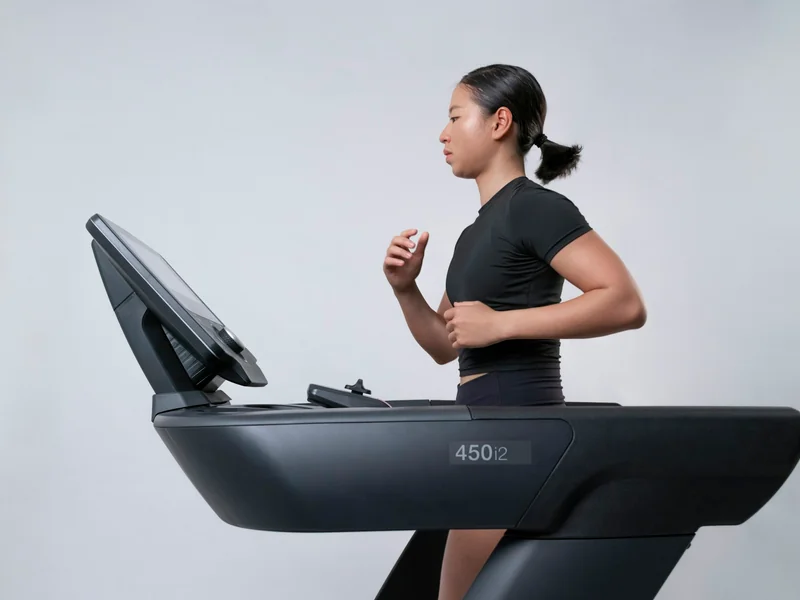
When you run outside, you move over the ground. On a treadmill, the ground moves under you. As long as the belt runs at a steady speed, those two situations are mechanically the same: your legs still have to support your body weight, push off with every stride and swing forward to catch up with a surface moving at your running speed. The belt doesn’t pull you along. If you stopped pushing, it would carry you straight off the back.
The large research reviews agree. A 2020 meta-analysis of 33 studies, pooling almost 500 runners, found that running mechanics on a motorized treadmill are largely comparable to running overground: stride, joint movement, ground forces and muscle activity were mostly similar.1
What is actually different
“Largely comparable” isn’t “the same”. These are the differences that hold up in the research, and what each one means for you.
No air resistance
Outside, you push through the air as you run. On a treadmill you’re standing still relative to the air, so that small cost disappears. This is the one way a treadmill really is a little easier at the same speed.
The classic study on this tested trained runners at a range of speeds on the road and on a treadmill set to 0%, 1%, 2% and 3% incline. A 1% incline best matched the energy cost of running outside.2 At the two slowest speeds tested, around 8:00 per mile (5:00 per kilometer) and slower, the road and a flat treadmill weren’t measurably different, because air resistance only becomes noticeable as you speed up.
In practice:
- Easy runs: at easy paces, a flat or 1% treadmill is close enough. Don’t worry about it.
- Faster running: for tempo runs, intervals and race-pace work, set the incline to 1% if you want the effort to match the road.
It often feels harder, not easier
Many runners find the same pace feels harder indoors, and the research backs them up. A meta-analysis comparing treadmill and overground running found that endurance performance in time trials was worse on a treadmill, with a moderate effect, while sprint performance wasn’t consistently different.3
There are several likely reasons: it’s often warmer with no breeze, there’s no scenery moving past to tell your brain you’re getting somewhere, and running at a fixed speed on an unfamiliar surface takes concentration. So if you’re thinking a treadmill run is the “easy option”, it’s usually the opposite.
A slightly different stride
The same 2020 review found a few consistent differences in how people run on a treadmill. Runners landed with a flatter foot, about 10 degrees flatter on average, and with less knee bend at landing. Peak push-off force was also different.1 The evidence for these is still low certainty, and none of it means a treadmill is bad for you. It does mean that if you do all your running on a treadmill, your legs get slightly less practice at the exact stride you’ll use outdoors.
Less load on your bones
In a small study that measured strain directly on the shinbone, the bone was loaded 48–285% more overground than on the treadmill at the same speed.4 That’s a double-edged result. Less strain may lower the risk of a stress fracture, which can help when you’re building mileage or coming back from a bone injury. But bone gets stronger in response to load, so a runner who trains almost entirely indoors gets less of that strengthening before a road race. The study only had three people in it, so treat it as a pointer rather than a firm number.
No hills down, no corners, no terrain
A treadmill handles uphill well. What it can’t do is downhill (most home treadmills don’t decline), tight turns, uneven ground, camber or wind. Downhill running in particular causes muscle soreness and needs practice. If your goal race is hilly or on trails, you need some of that training outside.
When a treadmill is the better choice
A treadmill isn’t a second-best option for bad days. In some situations it’s the right tool.
- When the alternative is not running. Darkness, ice, extreme heat, poor air quality, young children at home, or shift work. A treadmill run beats a skipped run every time.
- Safety. If you don’t feel safe running alone outside early in the morning or late at night, a treadmill takes that worry away.
- Precise sessions. Intervals and threshold work at an exact pace, with no traffic lights, intersections or hills to break the rhythm. The easy interval training sessions work well indoors.
- Hill training without hills. If you live somewhere flat, incline gives you sustained climbs at a controlled effort.
- Keeping easy runs easy. On a treadmill you can’t get dragged along by a group or chase a downhill segment. If you struggle to stay in zones 1 and 2 outside, indoors can help you learn what easy feels like.
- Coming back from injury. You can stop at any moment, you’re never miles from home, and the surface is predictable. Check with your doctor or physical therapist first if you’re returning from a bone injury.
- Hot-weather preparation. A warm room without a fan is a hard place to run, and the hydration guide explains why you’ll sweat more indoors. That’s a downside most of the time, but some runners use it on purpose before a hot race.
When you need to get outside
These recommendations are coaching guidance rather than research findings.
- If you’re training for a road race, aim to do at least one run a week outside, ideally your long run, and more of your running outside in the last six to eight weeks before the race. That gives your legs and bones the outdoor stride and load they’ll meet on race day.
- If your race is hilly or on trails, train on hills and terrain outside, especially downhills.
- Practice your race pace outside too. Pace control feels very different when nothing is setting the speed for you. It’s easy to learn your goal pace on a treadmill and then run the first mile of the race far too fast.
If you can only run on a treadmill for a while, that’s fine. Your fitness still builds. Just ease into outdoor running when you go back, with shorter runs for the first week or two, much as you would after any change of surface or shoes. Building weekly mileage safely covers how quickly to increase.
How to get the most from a treadmill
Set it up
- Use 1% incline for faster running. Leave it flat or at 1% for easy runs, as you prefer.
- Treat the speed display as approximate. Belt speed isn’t always perfectly calibrated, especially on older or gym machines. Run by heart rate or effort rather than chasing the number on the screen. Understanding heart rate zones shows you how to set your zones.
- Use a fan. Without airflow you’ll overheat sooner, and your heart rate will drift up even if the pace stays the same.
- Don’t hold the handrails. Holding on takes weight off your legs and changes your stride. If you need to hold on, slow the belt down.
- Give yourself a few minutes to settle. Start slowly and build up over the first five minutes or so. It takes a little while to stop thinking about the belt.
Know your conversions
Most US treadmills show speed in miles per hour (mph), but you probably think in minutes per mile. A few common conversions:
| Treadmill speed | Pace per mile | Pace per kilometer |
|---|---|---|
| 5.0 mph (8.0 km/h) | 12:00 | 7:27 |
| 6.0 mph (9.7 km/h) | 10:00 | 6:13 |
| 6.5 mph (10.5 km/h) | 9:14 | 5:44 |
| 7.0 mph (11.3 km/h) | 8:34 | 5:20 |
| 7.5 mph (12.1 km/h) | 8:00 | 4:58 |
| 8.0 mph (12.9 km/h) | 7:30 | 4:40 |
| 9.0 mph (14.5 km/h) | 6:40 | 4:09 |
| 10.0 mph (16.1 km/h) | 6:00 | 3:44 |
Three sessions that work well indoors
Easy run. 30–45 minutes at an easy effort, flat or at 1%. Easy means heart rate zones 1 and 2 only. If your heart rate goes into zone 3, slow the belt down or walk until it settles. Any time in zone 3 means the run was too hard.
Incline hill repeats. After a 10–15 minute easy warm-up, run 6 × 2 minutes at 4–6% incline at a hard but controlled effort, about 7–8 out of 10. Lower the incline to 1% and walk or jog easily for 2 minutes between each. Finish with a 10-minute easy cooldown. You get the strength benefits of hill running without the hard downhill landings.
Threshold intervals. After a 15-minute easy warm-up, run 3 × 8 minutes at your threshold effort (comfortably hard, roughly 7 out of 10, the pace you could hold for about an hour) at 1% incline, with 2 minutes of easy jogging between each. Finish with a 10-minute easy cooldown. Fixed belt speed makes it easy to hold an even effort, which is the whole point of threshold work. Why easy runs should feel easy explains how sessions like this fit into your week.
So, should you use one?
Yes, if it helps you run more consistently. Treadmill running is real running: the belt doesn’t carry you, your fitness carries over to the road, and for most people the same pace feels harder indoors, not easier.
The real differences are small and easy to manage. Set the incline to 1% for faster running to make up for the missing air resistance. Run by effort or heart rate, not the display. And if you’re training for an outdoor race, keep at least one run a week outside, and more as race day gets closer, so your legs are ready for hills, corners and a road that doesn’t set your pace for you.
This article is general information, not medical or coaching advice.
References
- Van Hooren B, Fuller JT, Buckley JD, et al. Is motorized treadmill running biomechanically comparable to overground running? A systematic review and meta-analysis of cross-over studies. Sports Medicine, 2020. ncbi.nlm.nih.gov
- Jones AM, Doust JH. A 1% treadmill grade most accurately reflects the energetic cost of outdoor running. Journal of Sports Sciences, 1996. doi.org
- Miller JR, Van Hooren B, Bishop C, et al. A systematic review and meta-analysis of crossover studies comparing physiological, perceptual and performance measures between treadmill and overground running. Sports Medicine, 2019. doi.org
- Milgrom C, Finestone A, Segev S, et al. Are overground or treadmill runners more likely to sustain tibial stress fracture? British Journal of Sports Medicine, 2003. pmc.ncbi.nlm.nih.gov