VO₂ max is one of the most talked-about numbers in running. Your watch probably shows you one. It’s also one of the most misunderstood. This article explains what VO₂ max measures, why it matters, where it stops mattering, and how to train it and track it.
What is VO₂ max?
VO₂ max stands for maximal oxygen uptake: the most oxygen your body can take in and use per minute during all-out exercise. “V” is volume, “O₂” is oxygen, and “max” is the ceiling. The idea goes back a century, to experiments in the 1920s showing that oxygen uptake rises with running speed until it reaches a plateau, and goes no higher however much faster you run.1
It’s usually given relative to body weight, in milliliters of oxygen per kilogram of body weight per minute (ml/kg/min). That lets you compare a 120-pound runner with a 200-pound runner.
For every minute you’re running, oxygen goes through a chain of steps:
- Your lungs bring air in and pass oxygen into your blood.
- Your heart pumps that oxygen-rich blood around your body.
- Your blood carries the oxygen, bound to hemoglobin in your red blood cells.
- Your muscles pull the oxygen out of the blood and use it to produce energy.
VO₂ max is the capacity of that whole chain. In healthy runners, the step that limits it is usually the heart: how much blood it can pump per minute, which depends mostly on how much blood it pushes out with each beat.2 Your lungs are rarely the bottleneck, so “lung capacity” is not what you’re training.
What’s a typical VO₂ max?
Figures vary a lot with age, sex, genetics and training. As a rough guide:
| Group | Typical VO₂ max (ml/kg/min) |
|---|---|
| Inactive adults | 30–40 (men), 25–35 (women) |
| Regular recreational runners | 45–55 (men), 40–50 (women) |
| Competitive club runners | 55–65 (men), 50–60 (women) |
| Elite distance runners | 70–85 (men), 60–75 (women) |
VO₂ max also falls with age, by roughly 10% per decade after about 30 in inactive people. Staying trained slows that decline considerably.3 So comparing yourself with runners your own age tells you more than comparing yourself with this table.
Why VO₂ max is an important metric
VO₂ max matters for two reasons: performance and health.
For performance, it sets your aerobic ceiling. Any race longer than about two minutes is run mostly on oxygen. The bigger your VO₂ max, the more energy you can produce aerobically, and the faster you can run before you have to rely on the much less sustainable energy systems that bring on the burning, heavy-legged feeling.
For health, it’s one of the strongest markers of long-term health there is. In a large study of more than 120,000 adults who completed a treadmill test, those with the lowest cardiorespiratory fitness had a far higher risk of death over the following years than those with the highest. The gap was as large as, or larger than, the gap linked to smoking or diabetes.4 You don’t need to race to benefit from a higher VO₂ max.
How VO₂ max affects your running
VO₂ max is important, but it’s one part of a bigger picture. Endurance performance comes down to three things working together:5
| Factor | What it is | What it means for you |
|---|---|---|
| VO₂ max | The size of your aerobic engine | Your ceiling |
| Lactate threshold | How much of that ceiling you can use for a sustained effort | How close to the ceiling you can race |
| Running economy | How much oxygen you need to run at a given pace | How far a liter of oxygen gets you |
Think of it like a car. VO₂ max is the size of the engine. Threshold is how hard you can run the engine without it overheating. Economy is your miles per gallon.
This is why two runners with the same VO₂ max can finish minutes apart in a race, and why VO₂ max is a poor predictor of who wins among runners of similar level. It’s a much better predictor across a wide range of ability, where a bigger engine clearly helps.
How much of your VO₂ max do you race at?
The longer the race, the smaller the share of your VO₂ max you can hold. Approximate figures for trained runners:
| Race | Share of VO₂ max |
|---|---|
| 2 miles (3km) | about 100% |
| 5K | about 95% |
| 10K | about 90% |
| Half marathon | about 85% |
| Marathon | about 75–80% |
For a 5K runner, VO₂ max is close to the whole story. For a marathoner, threshold and economy matter more, because nobody runs a marathon near their ceiling. That doesn’t make VO₂ max irrelevant for longer races: raising the ceiling tends to lift everything underneath it.
vVO₂ max: the speed that matters
The pace at which you reach your VO₂ max is called vVO₂ max (velocity at VO₂ max). For most trained runners it’s roughly the pace you could race flat-out for 6 to 10 minutes: around 2-mile (3km) race pace, or a little quicker than 5K pace. It combines your VO₂ max with your economy, so it predicts race performance better than VO₂ max alone.6 It’s also the pace most VO₂ max sessions are built around.
How to improve your VO₂ max
Easy running comes first
Most of your improvement in VO₂ max will come from consistent easy running in zones 1 and 2. Easy mileage makes your heart stronger and able to pump more blood with each beat, grows new capillaries around your muscle fibers, and increases the number of mitochondria (the parts of your cells that use oxygen) inside them. New runners see big gains in VO₂ max from easy running alone.
That’s why the best way to raise your VO₂ max is to follow the pattern successful endurance athletes use: roughly 80% of training at low intensity, with a small amount of hard work on top.7 Why easy runs should feel easy and how to build an aerobic base cover this side of things.
Then add high-intensity intervals
Once you’ve got a base, the most effective way to push VO₂ max higher is intervals that keep you at or near it for several minutes at a time. Your body adapts to the demand it’s put under. If you spend time with your heart pumping at close to its maximum, it adapts by getting better at it.
In one well-known study, runners who did 4 × 4 minutes at 90–95% of max heart rate with 3-minute jog recoveries, three times a week for eight weeks, improved their VO₂ max by about 7%. Groups that did the same total work as easy running or threshold running saw almost no change.8
Reps should last 2 to 5 minutes. Your oxygen uptake takes a minute or two to rise to its peak, so very short reps finish before you get there, and reps much longer than 5 minutes are too long to hold at this pace. Run them at about 9 out of 10: hard, but controlled enough that you finish each rep feeling you could run one more.
By the end of each rep your heart rate should be rising into zone 5 (90–95% of max heart rate). Heart rate lags behind effort, so it won’t get there in the first minute; judge the effort, not the watch. Recover with an easy jog roughly equal to the rep or a little shorter, which is long enough to run the next rep well but short enough that you don’t fully recover. Aim for a total of about 12 to 20 minutes of hard running per session. More isn’t better.9
How much can it improve?
It depends on where you start. If you’re new to running, VO₂ max can rise by 15–20% or more in your first months. Well-trained runners might gain a few percent a year.
Genetics also play a large part. A large family study found that people doing the same training program saw widely different gains, and that around half of that difference ran in families.10 If your VO₂ max hasn’t moved much, you haven’t failed. Threshold and economy keep improving for years after VO₂ max levels off, and they can make you faster on their own.
VO₂ max sessions to try
All of these start with a 10–15 minute warm-up of easy running in zone 2, plus a few short strides, and finish with a 10-minute easy cooldown. The recoveries are easy jogging. If your breathing hasn’t settled before the next rep, jog more slowly or walk.
The reps are timed rather than measured, so you can run them anywhere: a track, a flat road or a park.
1. First VO₂ max session: 5 × 2 minutes
- Reps: 5 × 2 minutes at about 9 out of 10
- Recovery: 2 minutes easy jog
- Total hard running: 10 minutes
This is the best way to start. The reps are short enough to pace well, and the recoveries are generous. Aim to run every rep at the same effort. If the last rep is much slower than the first, you started too hard.
2. The classic: 4 × 4 minutes
- Reps: 4 × 4 minutes, heart rate reaching 90–95% of max by the end of each rep
- Recovery: 3 minutes easy jog
- Total hard running: 16 minutes
This is the session from the study above, and it’s the backbone of most VO₂ max training. Each rep gives you two to three minutes at or close to your VO₂ max. Run the first minute of each rep a touch controlled and let the effort build.
3. Longer reps: 5 × 3 minutes, building to 5 × 4 minutes
- Reps: 5 × 3 minutes at around 2-mile (3km) race pace. Progress to 5 × 4 minutes over several weeks.
- Recovery: 2–3 minutes easy jog
- Total hard running: 15–20 minutes
For runners who have done the 4 × 4 session a few times and want more time near their ceiling.
4. Hill repeats: 6–8 × 2–3 minutes uphill
- Reps: 6 to 8 × 2–3 minutes up a steady hill at a hard, even effort
- Recovery: jog or walk back down
- Total hard running: 12–20 minutes
Running uphill raises your heart rate quickly while reducing the impact on your legs, so hills are a good choice for runners who pick up niggles from fast running on the flat. Use effort and heart rate here, not pace.
5. 30-30s: 2 sets of 10 × 30 seconds
- Reps: 30 seconds fast, at about vVO₂ max, then 30 seconds of easy jogging. Do 10 of these, jog 3–5 minutes, then repeat.
- Total hard running: 10 minutes
Short on-off efforts like this can keep oxygen uptake close to its maximum for longer than you might expect, because it doesn’t have time to fall far during the short recoveries.6 Many runners find them less intimidating than long reps. The first few reps will feel easy, but don’t speed up.
A six-week progression
If you’ve never done VO₂ max training, here’s a simple way to build up with one session a week:
| Week | Session | Hard running |
|---|---|---|
| 1 | 5 × 2 min, 2 min jog | 10 min |
| 2 | 6 × 2 min, 2 min jog | 12 min |
| 3 | 4 × 3 min, 2–3 min jog | 12 min |
| 4 (lighter) | 4 × 2 min, 2 min jog | 8 min |
| 5 | 4 × 4 min, 3 min jog | 16 min |
| 6 | 5 × 3 min, 2–3 min jog | 15 min |
After week 6, rotate between the 4 × 4, the 5 × 3–4 and the hills, keeping the total hard running between about 12 and 20 minutes.
Fitting it into your week
One VO₂ max session a week is enough for most runners. Experienced runners might do two in a block of training before a 5K, but not alongside a threshold session every week as well.
Keep the days either side easy or off; the day after a VO₂ max session should never be another hard run, and active recovery vs. rest days explains what to do instead. The rest of your week stays in zones 1 and 2, because the intervals only work on top of plenty of easy running.
Don’t add intervals and extra mileage at the same time. Hold your weekly distance steady for the first few weeks of hard sessions (see building weekly mileage safely).
Who should wait
VO₂ max intervals are the hardest sessions in running. If you’re still working through Couch to 5K, or you’ve been running consistently for less than about three months, stick to easy running for now, which is still raising your VO₂ max. When you’re ready for your first harder session, threshold intervals are a gentler place to start than VO₂ max work.
How to measure your VO₂ max
Lab test: the most accurate
A cardiopulmonary exercise test (CPET) measures VO₂ max directly. You run on a treadmill wearing a mask that analyzes the air you breathe in and out, while the speed or incline goes up every minute or two until you can’t continue. Your VO₂ max is the highest oxygen uptake recorded.
It’s accurate, and it usually gives you your max heart rate and threshold as well. Sports science labs at universities, sports medicine clinics and some performance centers offer it, often for somewhere between $100 and $300. It’s worth doing if you’re curious or want precise training zones. Most runners don’t need one.
Field test: the 12-minute run
The Cooper test is a simple way to estimate VO₂ max yourself.11 After a thorough warm-up, run as far as you can in exactly 12 minutes, ideally on a track. Then:
VO₂ max ≈ (35.97 × distance in miles) − 11.29
or, using meters: VO₂ max ≈ (distance in meters − 504.9) ÷ 44.73
| Distance in 12 minutes | Estimated VO₂ max (ml/kg/min) |
|---|---|
| 1.25 miles (2.0km) | about 34 |
| 1.5 miles (2.4km) | about 43 |
| 1.75 miles (2.8km) | about 52 |
| 2 miles (3.2km) | about 61 |
Pace it evenly. Going out too fast will cost you far more at the end than you gain at the start. Like any maximal effort, it’s a test for people with a few months of running behind them, not a first-week challenge.
Race times: the one you already have
A recent race result is one of the best indicators of your aerobic fitness, and many online race-time calculators convert it into an estimated VO₂ max. Strictly, what they give you is a “performance VO₂ max” that folds in your economy and threshold too. That’s no bad thing, since it tracks what matters on race day.
Your watch
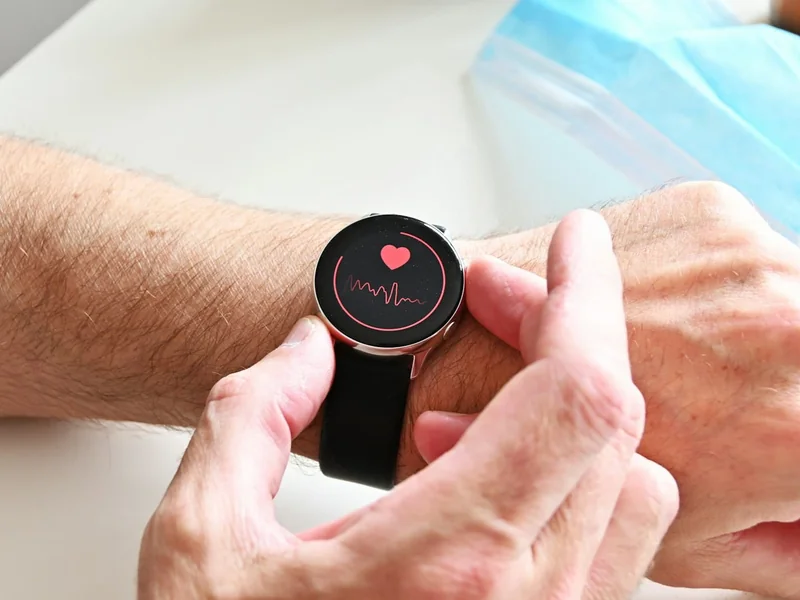
Most GPS watches estimate VO₂ max from the relationship between your pace and your heart rate on runs. They can be reasonably close on average, but reviews of the research have found individual estimates can be out by a considerable margin, and estimates based on running data are more accurate than those based on resting measurements.12
To get the most out of your watch estimate:
- Watch the trend rather than the number. A steady rise over months means your fitness is improving, even if the figure itself isn’t exact.
- Use an accurate heart rate. A chest strap is more reliable than a wrist sensor, and a bad heart rate reading means a bad estimate.
- Expect it to dip in the heat, on hilly routes, on trails and when you’re tired or ill. Those conditions push your heart rate up at a given pace, so the watch reads them as lower fitness.
- Set your max heart rate properly, since many watches use it in the calculation. Understanding heart rate zones explains how to get a better figure than 220 minus your age.
How often to test
Every two or three months is plenty. VO₂ max changes slowly, and more frequent testing mostly measures day-to-day noise: sleep, heat, stress and how hard your last week was. Sleep and running performance covers one of the biggest of those.
Raising your ceiling
VO₂ max is the most oxygen your body can take in and use per minute, measured in ml/kg/min and mostly limited by your heart. It matters for performance and for long-term health, since low cardiorespiratory fitness is one of the strongest risk factors for early death. It sets your ceiling, but threshold and running economy decide how close to that ceiling you can race, and the longer the race, the less VO₂ max alone explains.
Easy running in zones 1 and 2 builds most of it. Intervals of 2–5 minutes at 9 out of 10, with 12–20 minutes of hard running in total, raise it further. For most runners one VO₂ max session a week, with easy days either side, is enough, once you have a few months of consistent running behind you.
To track it, use a lab test for precision, a 12-minute field test or race times for a good estimate, or your watch to follow the trend.
This article is general information, not medical or coaching advice. Speak to a doctor before maximal exercise or testing, particularly if you have any heart-related risk factors.
References
- Hill AV, Lupton H. Muscular exercise, lactic acid, and the supply and utilisation of oxygen. QJM: Quarterly Journal of Medicine, 1923. doi.org
- Bassett DR, Howley ET. Limiting factors for maximum oxygen uptake and determinants of endurance performance. Medicine & Science in Sports & Exercise, 2000. doi.org
- Hawkins SA, Wiswell RA. Rate and mechanism of maximal oxygen consumption decline with aging. Sports Medicine, 2003. doi.org
- Mandsager K, et al. Association of cardiorespiratory fitness with long-term mortality among adults undergoing exercise treadmill testing. JAMA Network Open, 2018. doi.org
- Joyner MJ, Coyle EF. Endurance exercise performance: the physiology of champions. The Journal of Physiology, 2008. doi.org
- Billat LV. Interval training for performance: a scientific and empirical practice. Part I: aerobic interval training. Sports Medicine, 2001. doi.org
- Seiler S. What is best practice for training intensity and duration distribution in endurance athletes? International Journal of Sports Physiology and Performance, 2010. doi.org
- Helgerud J, et al. Aerobic high-intensity intervals improve VO2max more than moderate training. Medicine & Science in Sports & Exercise, 2007. doi.org
- Buchheit M, Laursen PB. High-intensity interval training, solutions to the programming puzzle. Part I: cardiopulmonary emphasis. Sports Medicine, 2013. doi.org
- Bouchard C, et al. Familial aggregation of VO2max response to exercise training: results from the HERITAGE Family Study. Journal of Applied Physiology, 1999. doi.org
- Cooper KH. A means of assessing maximal oxygen intake. JAMA, 1968. doi.org
- Molina-Garcia P, et al. Validity of estimating the maximal oxygen consumption by consumer wearables: a systematic review with meta-analysis and expert statement of the INTERLIVE network. Sports Medicine, 2022. doi.org