Letting go of a good pair
The shoes still look fine, they’re comfortable, they got you through a training block, and retiring them feels wasteful. So how many miles is too many?
Nobody knows a precise number for you. The usual figure is 300–500 miles (500–800 km), and it’s a reasonable point to start paying attention. But it rests on less evidence than its popularity suggests, and your shoes will tell you more than any number.
Where the 300–500 mile figure comes from
Most of the guideline traces back to a 1985 study.1 Researchers ran shoes through a machine that repeatedly struck the midsole, and also tested shoes worn by real runners. In the machine tests, shoes kept around 75% of their original shock absorption after 50 miles (80 km), around 67% after 100–150 miles (160–240 km), and under 60% somewhere between 250 and 500 miles (400–800 km). The shoes worn by real runners held up somewhat better, keeping around 70% at 500 miles.
Later laboratory work on ethylene-vinyl acetate (EVA), the foam used in most midsoles then and many now, showed why: repeated compression gradually damages the foam’s internal cell structure, and pressure under the heel rises as it does.2
That’s the case for the figure. Here’s why it deserves caution:
- The shoes were very different. Foams have changed a great deal since the 1980s, and some modern materials are far more durable.
- Lost cushioning isn’t the same as injury. We’re not aware of any good study showing that runners in shoes past a given mileage get injured more often. The link is plausible but unproven.
- Cushioning itself is a weak injury factor. Shoe research generally finds that training load matters far more than footwear, and that comfort is the most useful guide to choosing shoes.3
So 300–500 miles is a planning figure, not a deadline. In our own running, shoes have often gone comfortably past it.
What makes shoes wear faster or slower
Body weight. More load per step compresses the midsole further, and many heavier runners notice shoes going flat sooner. That’s mechanically sensible, but no well-controlled study gives a reliable mileage figure by weight, so be wary of online claims that put a precise percentage on it. Our guide to running shoes for heavier runners covers this in more detail.
Surface. Rough asphalt and concrete wear the outsole (the rubber tread) faster than smooth paths or a treadmill. Trails are kinder to the tread but harder on uppers, with roots, rocks and mud working at the stitching.
Foam type. Traditional EVA foams are durable and fairly firm. Thermoplastic polyurethane (TPU) foams are heavier but tend to last a long time. The light, springy polyether block amide (PEBA) foams in race shoes and many premium trainers are commonly reported to lose their bounce sooner, often within 200–300 miles (320–480 km). We cover what that means for cost in are expensive running shoes worth it?
Running style. Heel strikers tend to grind down the outer heel, forefoot runners wear the front, and runners who scuff their feet wear through rubber quickly. Two people in the same shoe can get very different mileage.
Everyday wear. Walking, gym sessions and errands in your running shoes add wear your log doesn’t count.
Physical signs a shoe is worn out
These matter more than the mileage total:
- New aches with no change in your training. Often the first sign.
- Creasing and compression in the midsole. Deep wrinkles in the foam, especially at the heel, mean it no longer springs back. Tread wear alone matters less.
- A flat or “dead” feel. Try on a new pair of the same model: the difference is often obvious.
- Uneven lean. Set the shoes on a table and look from behind. A noticeable tilt means the midsole has worn unevenly.
- Outsole worn through to the foam. Once the rubber is gone, the midsole wears fast and grip suffers in the wet.
- A collapsed heel cup or torn upper. If your foot slides around, the shoe no longer holds you securely.
One sign alone isn’t always decisive. Two or three together, especially new aches plus a flat feel, mean it’s time.
Rotating pairs
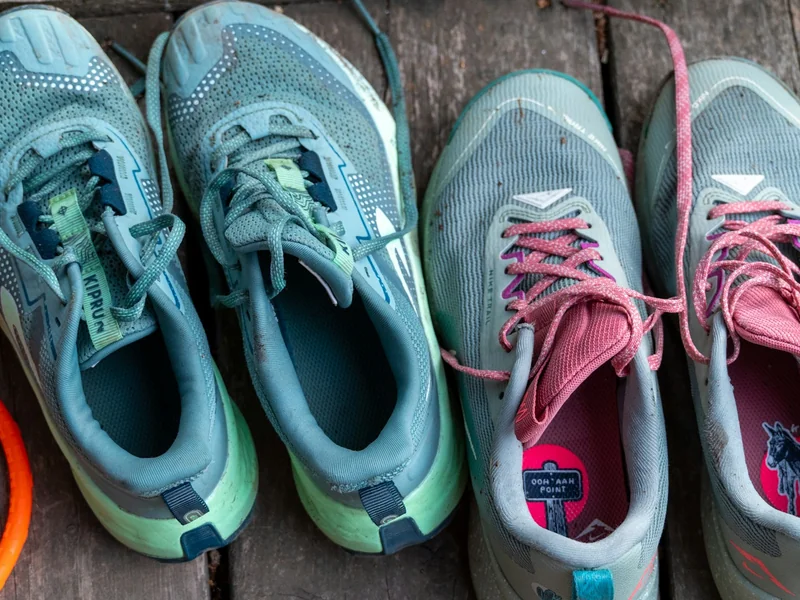
Running in two or more pairs spreads the miles, so each lasts longer in calendar time at no extra cost per mile. In a study of 264 recreational runners, those who used more than one pair had a 39% lower risk of running-related injury.4 It was an observational finding, so it doesn’t prove rotation caused the difference.
Rotation also makes retirement easier. A newer pair alongside the old one gives you a direct comparison, so you can feel when the old pair has gone flat. The running shoe rotation guide covers when a second pair is worth buying.
How to keep track of mileage
You can’t judge “around 400 miles” without a running total. The easiest options:
- Strava. Add shoes under My Gear in your settings, then pick the pair on each run. You can set an email reminder at a chosen mileage: it defaults to 250 miles and can be raised to 800. Reminder settings are only on the Strava website, not in the app.
- Garmin Connect. Add shoes in the Gear section, set a maximum distance, and choose a default pair for running so it’s added to each run automatically. If you swap pairs, change it on the activity afterward.
- Other platforms vary. If yours has no gear tracking, a spreadsheet works fine.
Treat the reminder as a prompt to check the shoes for the signs above, not a replacement date.
When it’s time
Retired running shoes make good walking or gardening shoes, and many running stores and charities collect old pairs for reuse or recycling.
If you’re still reluctant, think about cost: a $130 pair that lasted 450 miles has cost under 30 cents a mile. Another month in shoes that make your legs ache isn’t a saving. And remember that no shoe makes up for training errors. See building weekly mileage safely.
Key takeaways
- 300–500 miles (500–800 km) is a cue to start checking, based mostly on decades-old research on older foams.
- There’s no good evidence that a specific mileage causes injury.
- Body weight, rough surfaces, soft PEBA foams and everyday wear all shorten lifespan.
- Replace shoes when new aches, midsole creasing, a dead feel or uneven lean appear, especially together.
- Rotate pairs and track mileage, using reminders as a prompt to inspect, not to replace.
For choosing the next pair, see choosing the right running shoes.
Common questions
How many miles should you put on running shoes?
The usual guideline is 300–500 miles (500–800 km), but it’s a cue to start checking your shoes, not a deadline. It’s based mostly on decades-old research on older foams, and many shoes go comfortably past it.
How do I know when my running shoes are worn out?
Look for new aches with no change in your training, deep creasing in the midsole, a flat or “dead” feel, a noticeable lean when the shoes sit on a table, or rubber worn through to the foam. One sign alone isn’t always decisive, but two or three together mean it’s time.
Do heavier runners wear out running shoes faster?
Probably, since more load per step compresses the midsole further and many heavier runners notice shoes going flat sooner. However, no well-controlled study gives a reliable mileage figure by weight, so be wary of precise percentages online.
Does rotating running shoes make them last longer?
Yes, in calendar time. Spreading your miles across two or more pairs means each pair lasts longer at no extra cost per mile, and a newer pair alongside the old one makes it easier to feel when the old one has gone flat.
This article is general information, not medical advice.
References
- Cook SD, Kester MA, Brunet ME. Shock absorption characteristics of running shoes. American Journal of Sports Medicine, 1985. pubmed.ncbi.nlm.nih.gov
- Verdejo R, Mills NJ. Heel–shoe interactions and the durability of EVA foam running-shoe midsoles. Journal of Biomechanics, 2004. pubmed.ncbi.nlm.nih.gov
- Nigg BM et al. Running shoes and running injuries: mythbusting and a proposal for two new paradigms: ‘preferred movement path’ and ‘comfort filter’. British Journal of Sports Medicine, 2015. pubmed.ncbi.nlm.nih.gov
- Malisoux L et al. Can parallel use of different running shoes decrease running-related injury risk? Scandinavian Journal of Medicine & Science in Sports, 2015. Wiley