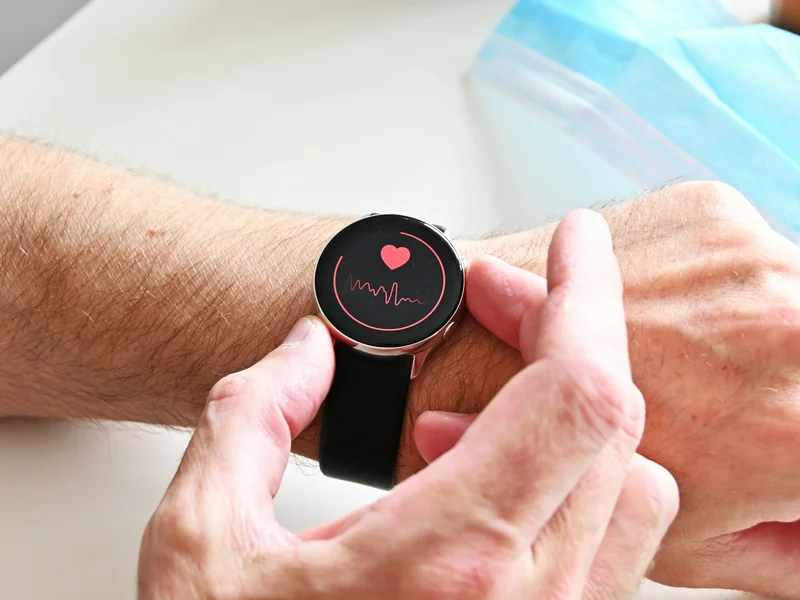
The number on your watch you probably ignore
Most running watches, smart rings and fitness bands now give you a heart rate variability (HRV) reading every morning. Many runners glance at it, see a number and a color, and move on. Others check it obsessively and cancel a workout because it dipped by two points.
Neither is the right way to use it. HRV is one of the few recovery measures with solid research behind it, but it only works if you record it consistently and read the trend, not the single day. This article covers what it is, how to measure it, what it means for your running and how to put it to work.
What HRV is
Your heart doesn’t beat like a metronome. If your heart rate is 60 beats per minute (bpm), the gaps between beats aren’t all exactly one second. One might be 0.95 seconds, the next 1.06, the next 0.98. Heart rate variability is the variation in time between consecutive heartbeats, measured in milliseconds.1
That variation comes from your autonomic nervous system, the part of your nervous system that runs things automatically. It has two branches pulling in opposite directions:
- The sympathetic branch is the “fight or flight” side. It speeds the heart up and makes the beats more regular.
- The parasympathetic branch is the “rest and digest” side, working mainly through the vagus nerve. It slows the heart down and lets the gaps between beats vary more from beat to beat.
When you’re rested and relaxed, the parasympathetic side has more influence, and HRV tends to be higher. When your body is under stress, whether from hard training, poor sleep, illness, alcohol or a rough week at work, the balance shifts toward the sympathetic side and HRV tends to fall.
So, counterintuitively, more variability is usually a good sign. A heart that can make quick, small adjustments beat to beat is a heart under less strain.
The number your device shows
There are many ways to calculate HRV. The one most sports research and most consumer devices use is rMSSD (the root mean square of successive differences), which captures how much each beat-to-beat gap differs from the one before. It mainly reflects parasympathetic activity and is reliable over short recordings of a minute or two, which is why apps and wearables favor it.2 Some apps show it as a log-transformed score or on a 1–100 scale, but it’s usually rMSSD under the hood.
Your number is personal
HRV varies enormously between people. A healthy runner might sit at 30 milliseconds (ms) or 120 ms, and both could be perfectly fit. In one analysis of more than 28,000 people using a smartphone HRV app, HRV fell with age and was only weakly linked to how active people were.3 Genetics play a large part too.
That means comparing your HRV with a friend’s, or with a chart online, tells you almost nothing. The only useful comparison is with your own normal.
Why HRV matters for runners
Training works by stressing your body and then letting it recover and adapt. Get the balance right and you get fitter. Pile on stress faster than you recover and you drift toward overreaching, illness and injury.
The trouble is that fatigue is hard to judge from the inside. Motivation, caffeine and a training plan all push you to keep going. HRV gives you an outside measure of how your nervous system is coping.
After a single run, it takes time for the parasympathetic side to fully return to normal. A review of the research found that this recovery takes up to 24 hours after an easy run, 24–48 hours after a threshold session, and at least 48 hours after high-intensity work, with fitter runners recovering faster.4 That lines up with the traditional advice to follow a hard day with an easy one.
Over weeks, the trend matters more. In a case study of two elite triathletes training more than 20 hours a week, one athlete’s weekly HRV average stayed stable while the other’s drifted steadily down in the lead-up to a key race. The second athlete raced poorly, was diagnosed as overreached and then developed shingles.5 The decline was visible in the data weeks before it was obvious in performance.
HRV also responds to things outside training. Large-scale app data found that heavy drinking cut next-morning HRV by about 12% and illness by about 10%, compared with less than 5% after training.3 HRV is sensitive to stress, but it doesn’t tell you which stress. That’s both its strength and its main limitation.
How to record HRV
HRV is easy to measure badly. Breathing, posture, whether you’ve just checked your email, and a full bladder can all move the number. Good data comes from measuring the same way every time.
Option 1: overnight with a wearable
Many watches, rings and bands measure HRV automatically while you sleep and report an overnight or early-sleep average. This is the lowest-effort option, because you just have to wear it to bed.
Research on recreational runners found that nighttime HRV from a wrist device was highly reliable from night to night and dropped clearly after a hard 3,000-meter (about 1.9-mile) time trial.6 A follow-up study found that HRV in the first few hours of sleep was the segment most closely linked to how runners responded to a block of hard training.7
The downsides are that you have to sleep in the device, and the timing and method differ between brands, so you can’t compare numbers across devices.
Option 2: a morning measurement
The alternative is a short, deliberate reading each morning using a chest strap paired with an HRV app, or an app that reads your pulse through your phone’s camera. A study comparing a phone camera, a chest strap and a hospital electrocardiogram (ECG) found the differences between them were trivial for resting rMSSD, so you don’t need expensive kit.8
To make morning readings consistent:
- Measure as soon as you wake up, after using the bathroom if you need to, but before coffee, food, your phone or any exercise.
- Use the same position every day. Lying down or sitting both work. Pick one and stick with it.
- Breathe normally and stay still. Don’t talk or check messages.
- Record for 1–2 minutes. Most apps handle this for you.
- Do it most days. You don’t need a reading every single morning, but research on athletes found you need at least three valid readings a week, ideally more, for the weekly average to be meaningful.9
Which should you choose?
Use whichever you’ll actually stick with. If you already sleep in a watch or ring, the overnight reading is good enough for most runners. If you don’t want to wear something to bed, or you want a little more control over the conditions, a 60-second morning reading with a chest strap or your phone works just as well. What matters is that you pick one method and don’t switch, because your baseline from one won’t carry over to the other.
What your HRV is telling you
Build a baseline first
Give yourself at least 2–4 weeks of normal training before reading anything into the numbers. That shows you your usual range. Many apps calculate this for you and show it as a shaded “normal” band.
Watch the 7-day average, not today’s number
Daily HRV bounces around a lot. A single low reading after a late dinner or a restless night means very little. What matters is your 7-day rolling average compared with your longer-term normal range.10
Here’s how to read the common patterns:
| What you see | What it likely means | What to do |
|---|---|---|
| 7-day average within your normal range | You’re coping with your current training | Train as planned |
| One low day, average still normal | A short-term stressor (poor sleep, a hard session, alcohol) | Usually nothing; train as planned, or swap a hard session for tomorrow if you also feel bad |
| 7-day average trending down below normal for several days | Stress is building faster than you’re recovering | Ease off: replace hard sessions with easy running or rest until it recovers |
| Low HRV with a raised resting heart rate and feeling unwell | Possibly coming down with something | Rest; don’t run hard through illness |
| Average gradually rising over months | Your aerobic fitness and recovery are improving | Keep doing what you’re doing |
The “high is bad” exception
Usually a high reading is good. But a sudden, unusually high HRV, especially alongside a lower resting heart rate, heavy legs and flat performance, can sometimes appear during heavy training blocks and is associated with deep fatigue in some athletes.10 If your numbers look unusually “good” but you feel terrible, believe how you feel.
Day-to-day swings matter too
The same triathlete case study found that the overreached athlete’s HRV didn’t just fall; it also became less variable from day to day.5 A gradual drop in your average combined with unusually flat daily readings is worth paying attention to.
What HRV can’t tell you
HRV reflects your nervous system, not everything else. Research on recovery after exercise found that heart rhythm recovers on a different timeline from muscle damage and energy stores.4 Your HRV can be back to normal while your legs are still sore from a long run or a race. HRV is one input, alongside how you feel, how your legs feel and how your runs are going.
How to use HRV in your training
HRV-guided training
The most promising use of HRV is to adjust when you do hard sessions, not whether you train. The approach in the research is simple: if your HRV is within your normal range, do the planned hard session; if it’s below, swap it for an easy run or rest, and do the hard session on a later day.
Several studies have compared this with following a fixed plan:
- In a 4-week study of moderately fit men, the group that used morning HRV to decide whether to run hard or easy improved their maximal running speed more than the group following a fixed schedule.11
- In an 8-week study of 40 recreational runners, the HRV-guided group did fewer hard sessions (about 13 against 18), yet improved their 3,000-meter (about 1.9-mile) time while the fixed-plan group didn’t significantly improve.12
- In a 15-week study of recreational runners, the group whose training was adjusted twice a week using nighttime HRV, how recovered they felt and their heart rate at a given pace improved their 10K (6.2-mile) time by about 6%, against about 3% for the group following a fixed plan. No one in the individualized group was a low responder for maximal running speed.13
The overall picture is encouraging but modest. A 2021 meta-analysis pooling these kinds of studies found that HRV-guided training was clearly better at protecting HRV, with fewer people responding badly to training. For fitness and performance, the advantage was small and not statistically significant.14
So HRV-guided training probably won’t make you dramatically faster. What it does well is reduce the chance of a bad response to training, by stopping you from stacking hard sessions on days when your body isn’t ready. For most recreational runners juggling work, family and sleep, that’s exactly the problem worth solving.
A simple way to start
- Record HRV most days using one consistent method.
- Collect 2–4 weeks of baseline while training normally.
- Before each hard session, check your 7-day average against your normal range, and check in with yourself: how did you sleep, how do your legs feel, are you unusually stressed?
- If both the HRV trend and how you feel are fine, do the session. If your HRV is down and you feel off, swap the hard session for an easy run in zones 1–2, or take a rest day. Move the hard session to later in the week.
- Don’t change easy days. Easy running is already low stress. HRV is most useful for deciding when to place hard sessions and long runs, not for agonizing over whether to do a 4-mile (6.4 km) recovery jog.
If you’re not sure what counts as easy, our guides to heart rate zones and why easy runs should feel easy cover it.
Use it to spot trouble early
Even if you don’t want to guide every session by HRV, it’s a useful early warning. A steady slide in your weekly average over a couple of weeks while you’re building mileage is a sign the increase is outpacing your recovery. That’s the time to take a down week, before you’re forced to by illness or injury. Our article on active recovery vs rest days covers what to do with that time.
Use it to understand your lifestyle
Because HRV reacts to everything, it’s a good teacher. Many runners discover that two beers, a late heavy meal or a short night hits their HRV harder than their toughest workout. If your average keeps dipping, look at sleep, alcohol and stress before you blame the training.
Use it to track long-term fitness
As aerobic fitness improves, resting heart rate tends to fall and HRV tends to rise. A slow upward drift in your baseline over months of consistent training is a sign your aerobic base is developing.
Common mistakes
- Reacting to a single reading. One low morning is noise. Look at the 7-day trend.
- Comparing your number with other people’s. Your 45 ms might be excellent for you.
- Switching devices or methods. A new watch means a new baseline.
- Measuring inconsistently. Different times, positions and pre-measurement routines make the data meaningless.
- Letting the number override common sense. If your HRV is normal but you’re feverish, rest. If it’s slightly low but you feel great, a planned session is usually fine.
- Obsessing. If checking your HRV makes you anxious, that stress shows up in the number. Look weekly instead of daily, or take a break from it.
Should you bother?
HRV isn’t essential. Plenty of runners train well using a sensible plan, a training log and honest attention to how they feel. But if you already own a device that measures it, it costs nothing to use, and it gives you an objective check on recovery that’s hard to get any other way.
Record it consistently, give yourself a few weeks of baseline, read the weekly trend rather than the daily number, and use it mainly to decide when to schedule your hard sessions. Combined with how you feel, that’s enough to train harder on good days and back off before small problems become big ones. If you’re still choosing a device, our guide to which running devices are worth buying covers the options.
This article is general information, not medical or coaching advice. HRV apps are not designed to diagnose heart conditions. If you notice an irregular heartbeat, chest pain or unusual breathlessness, see a doctor.
References
- Task Force of the European Society of Cardiology and the North American Society of Pacing and Electrophysiology. Heart rate variability: standards of measurement, physiological interpretation and clinical use. Circulation, 1996. PubMed
- Shaffer F, Ginsberg JP. An overview of heart rate variability metrics and norms. Frontiers in Public Health, 2017. PubMed
- Altini M, Plews D. What is behind changes in resting heart rate and heart rate variability? A large-scale analysis of longitudinal measurements acquired in free-living. Sensors, 2021. PubMed
- Stanley J, Peake JM, Buchheit M. Cardiac parasympathetic reactivation following exercise: implications for training prescription. Sports Medicine, 2013. PubMed
- Plews DJ et al. Heart rate variability in elite triathletes, is variation in variability the key to effective training? A case comparison. European Journal of Applied Physiology, 2012. PubMed
- Nuuttila OP et al. Reliability and sensitivity of nocturnal heart rate and heart-rate variability in monitoring individual responses to training load. International Journal of Sports Physiology and Performance, 2022. PubMed
- Nuuttila OP et al. Morning versus nocturnal heart rate and heart rate variability responses to intensified training in recreational runners. Sports Medicine – Open, 2024. PubMed
- Plews DJ et al. Comparison of heart-rate-variability recording with smartphone photoplethysmography, Polar H7 chest strap, and electrocardiography. International Journal of Sports Physiology and Performance, 2017. PubMed
- Plews DJ et al. Monitoring training with heart rate-variability: how much compliance is needed for valid assessment? International Journal of Sports Physiology and Performance, 2014. PubMed
- Plews DJ et al. Training adaptation and heart rate variability in elite endurance athletes: opening the door to effective monitoring. Sports Medicine, 2013. PubMed
- Kiviniemi AM et al. Endurance training guided individually by daily heart rate variability measurements. European Journal of Applied Physiology, 2007. PubMed
- Vesterinen V et al. Individual endurance training prescription with heart rate variability. Medicine and Science in Sports and Exercise, 2016. PubMed
- Nuuttila OP et al. Individualized endurance training based on recovery and training status in recreational runners. Medicine and Science in Sports and Exercise, 2022. PubMed
- Manresa-Rocamora A et al. Heart rate variability-guided training for enhancing cardiac-vagal modulation, aerobic fitness, and endurance performance: a methodological systematic review with meta-analysis. International Journal of Environmental Research and Public Health, 2021. PubMed